First, stabilize the injury—keep the head, neck, and spine aligned, and immobilize suspected fractures before you move your dog. If a spinal injury’s possible, use a flat rigid board or improvised stretcher. No board? Grip a blanket at all four corners. Lift with your legs using squat mechanics, then choose the smoothest, fastest route to care, minimizing jolts and elevation. There’s more you’ll want to know before you attempt that solo carry.
TLDR Key Takeaways
- Use a flat rigid board or improvised stretcher when a spinal injury is possible, prioritizing immobilization before movement.
- When no board is available, grip a blanket stretcher at all four corners to keep the dog stable.
- Lift with proper squat mechanics: knees bent to dog level, feet shoulder-width apart, chest up, driving upward with thighs.
- Choose support based on terrain—a non-slip sling for hands-free treks or a trekking-pole stretcher with rigid rails for distance.
- Map exit routes first, picking the smoothest, least-jolting line while minimizing elevation gain and prioritizing fast time to care.
Stabilize Your Injured Dog Before You Lift
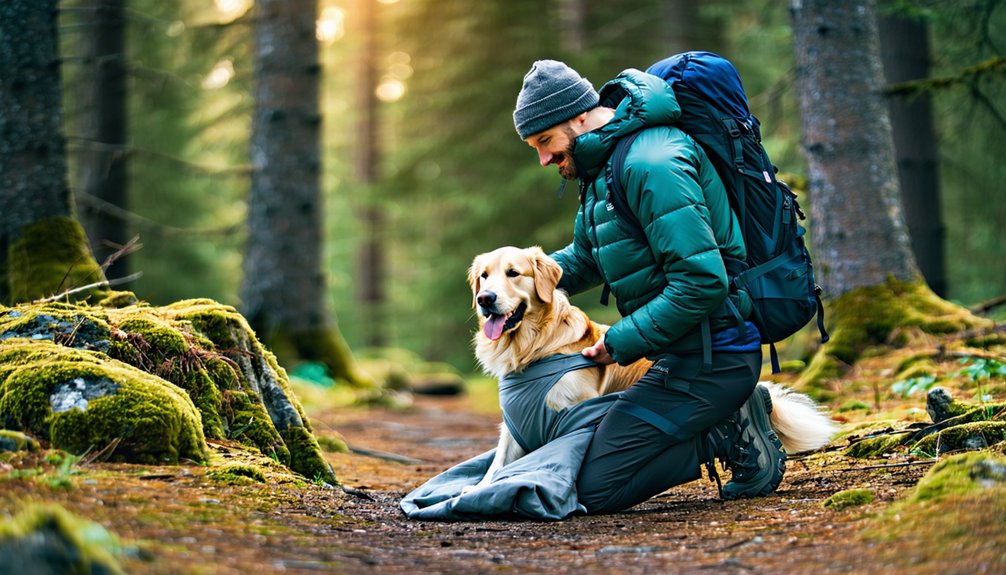
Before you even think about lifting your dog, stabilize the injury—rushing this step can turn a manageable problem into a permanent one. Handle your dog as little as possible, and encourage them to lie down and stay in the most comfortable position.
If you suspect a fracture or spinal issue, don’t let them walk or stand. Immobilize before movement, because spinal immobilization is essential for reducing further nerve damage.
Keep the head, neck, and spine aligned, avoiding any twisting or jolting. If your dog’s unconscious, hold the head in normal alignment with the body.
Brace using boards—rigid plywood or a sturdy board works best for suspected spinal trauma.
We’ve all faced this fear; stay calm, work slowly, and stabilize fully before attempting any lift.
Check Your Dog for Bleeding, Shock, and Fractures
Once your dog’s stable, run a fast head-to-tail check for the three threats that kill quickly: bleeding, shock, and fractures. Work fast and trust your hands—you’ve got this. For external bleeding, press firmly with a clean cloth or towel; if blood soaks through, add another layer rather than removing the first. Don’t stop pressing until bleeding’s controlled.
| Triage Priorities | What You Check |
|---|---|
| Bleeding | Damp matted fur, pooling, soaked dressings |
| Shock | Gum color—pale or white means emergency |
| Respiratory warning | Rapid or labored breathing, coughing |
| Fractures | Swelling, deformity, refusal to bear weight |
Pale gums without visible blood suggest internal bleeding—move fast. For suspected fractures, perform limb immobilization with splints before you lift, minimizing movement throughout.
How Do You Know If Your Dog’s Spine Is Injured?
Fractures aren’t the only structural injury that demands extreme care before you lift—a damaged spine can turn a rescue into a tragedy if you move your dog wrong.
Start your mobility assessment by watching for sudden hind-limb weakness or collapse, the classic pattern after trauma.
Does your dog drag its back legs, knuckle over, or stagger like its rear end is drunk?
Check for pain along the neck or back: vocalizing when touched, an arched back, stiffness, or a tucked tail signal trouble.
Test spinal reflexes by noting whether your dog can bear weight, posture to urinate, or feel deep pain.
Loss of bladder or bowel control is an emergency.
When you spot these signs, treat the spine as injured and stabilize accordingly.
Calm a Dog That Snaps or Panics in Pain
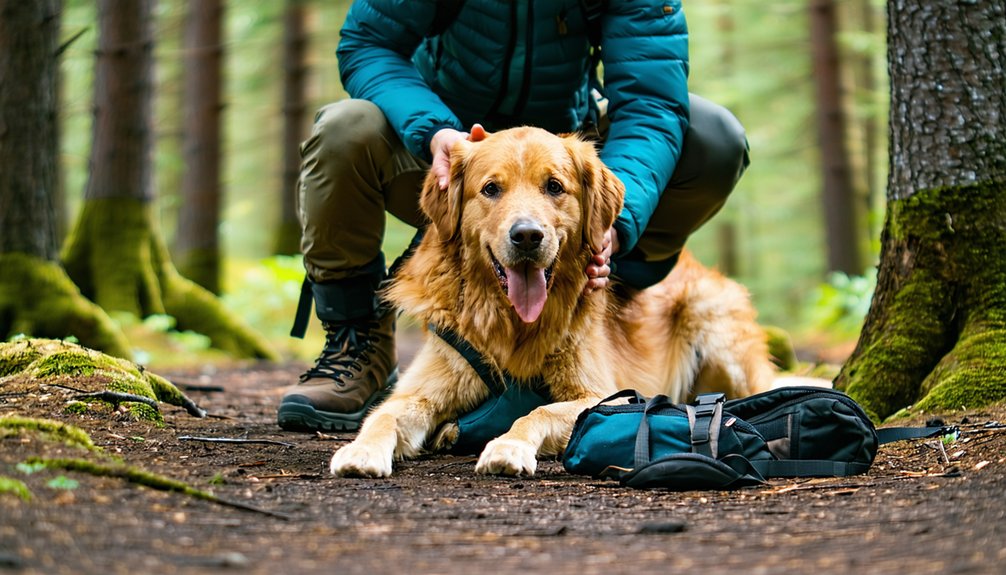
A dog in pain often snaps or panics, and that reaction isn’t aggression—it’s fear. Your first job is getting your dog away from whatever triggered it, then creating distance and finding a low stimulation spot where you both can regroup.
Speak in a low, steady voice and keep your movements slow and fluid. Avoid eye contact, turn partially side-on, and use controlled breathing to lower your own arousal—your dog reads your calm.
Don’t force touch; if approaching increases stress, step back and give a safe space instead.
When your dog tolerates it, offer slow, gentle strokes on the back or chest, never near the injury. Never punish snapping or crowd a panicked dog.
Forceful handling only intensifies fear and deepens the defensive reaction.
Pick the Safest Carry for a 60-lb Dog
Weight is the problem that drives every decision here. At 60 pounds, you can’t rely on your arms alone, so smart weight distribution becomes your priority. If a partner shows up, a two person assist cradle lift is your safest bet—one of you supports the chest and shoulders, the other the pelvis and hindquarters, keeping the body horizontal.
Going solo? Reach for a flat rigid board or improvised stretcher first, especially if you suspect spinal injury, because it minimizes twisting and flexion. No board? A blanket stretcher gripped at all four corners is your next best choice.
Skip the arm-only cradle and fireman’s carry for long hauls. They concentrate load, strain you both, and leave the dog dangerously unstable.
Lift With Your Legs, Not Your Spine
Your back is the first thing that fails when you lift 60 pounds wrong. Out here, you don’t have a backup, so proper squat mechanics matter.
Kneel or squat to your dog’s level, feet shoulder-width apart, and brace your torso with your chest up.
Bring your dog into the power zone, close to your hips, before rising.
Now drive upward with your thighs—not your lower back.
Back neutral lifting means keeping your spine straight and rigid while your legs do the work.
Move at a steady, controlled speed; no jerky pulls.
When you set your dog down, mirror the motion: bend your knees, keep your spine neutral, lower gently.
Trust these mechanics, and you’ll protect both your spine and your dog.
Master the Cradle Lift Without Back Strain
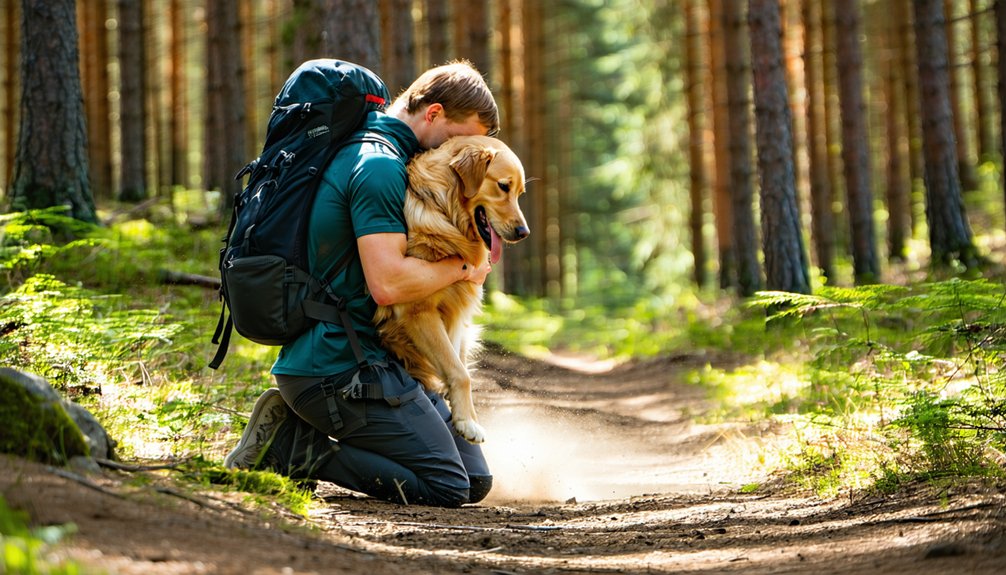
Position your arms before you lift, because the cradle’s strength comes from where you place them. Slide one arm under the chest and around the front legs; let the other support the hindquarters.
You’re forming a cradle beneath your dog, not pulling on limbs or collar. Keep the body level and tight to your torso for grip stability and control.
Bend your knees deeply, keep your spine straight, and drive upward with your legs—slow and deliberate. Spread support across chest and hind end, avoiding any injured area or compressed abdomen.
Build training balance through short repetitions, and raise practice from a stable surface to ease emergency lifts.
Rehearse controlled lowering and resetting so your solo carry feels secure when it matters most.
Build a Dog Sling From a Blanket or Coat
When the cradle lift won’t work for a longer trek, a sling distributes your dog’s weight and frees your hands for balance on rough terrain. Start with a sturdy fleece or thick cotton blanket, and choose non slip fabric—skip satin, which fails under load.
Measure your dog first so the sling matches the job:
- Weigh your dog, since a 60-pounder needs double-layered fabric for load-bearing support.
- Measure chest circumference and shoulder-to-hip length to set your dimensions, adding allowance for seams and comfort.
- Fold the blanket lengthwise, then sew both ends into two loops or knot opposite corners into a carrying cradle.
Reinforce seam strength with double-fold stitching and backstitch high-stress points.
Test the finished sling with a similar-weight object before trusting it.
Make a Dog Stretcher With Trekking Poles
Although a sling works for shorter hauls, a rigid stretcher built from trekking poles becomes the better tool when you’ve got real distance to cover or a 60-pound dog that can’t collapse inward during transport.
Lay your fabric flat first, then position one pole along each long side to form parallel rails.
Add crossbars or a travois-style brace to hold the poles at constant width.
Start and finish your lashings with clove hitches, distributing attachment points along the poles rather than relying on one central tie.
Pull the bed taut, keeping it slightly narrower than your pole spacing.
Like everyone who’s mastered improvised stretcher practice, run rope tension checks before lifting—loose connections twist during turns.
Keep hauls short, lift slowly, and stabilize the head if spinal injury’s possible.
When Dragging Your Dog Beats Carrying
A stretcher isn’t always your best move. When the terrain turns steep, uneven, or littered with debris, dragging your dog can beat lifting—reducing strain on your body and limiting risky repositioning.
Dragging shines when movement must stay minimal, steady, and controlled, and it often protects an injured spine better than repeated hoisting.
Reach for dragging when you face these situations:
- Suspected back or spinal injury, where keeping the body level and aligned matters most
- Severe pain, fear, or agitation, since a struggling dog may bite during a lift
- Breathing difficulty, where chest compression from carrying worsens things
Improvise drag surfaces from a tarp, blanket, coat, or rigid board. Manage route obstacles first—clear rocks, roots, and branches—then move slowly to avoid jolting.
Plan the Shortest, Smoothest Exit Route
Before you lift a single paw, settle the question that shapes everything else: where are you taking your dog, and by what path?
Map exit options first—trailheads, service roads, and alternate access points—then pin the nearest emergency vet for each, including after-hours clinics.
This is time to care planning, and it beats scenery every time when injury severity’s uncertain.
Pick the line with the least jolt per step.
Favor wide, even tread over loose rock or off-trail travel.
Minimize elevation gain, technical footing, and river crossings, since each one adds bounce and risk.
If a direct exit’s rougher, choose the smoothest feasible route that still reaches care fast.
You’re not just hiking out—you’re protecting a teammate.
Plan like one.
What to Pack in a Dog Transport Kit
Your route’s only as good as the gear that gets your dog down it. Pack smart, and you’ll move faster when it matters most.
Start with immobilization and carrying gear: a secure carrier sized for standing and turning, a well-fitting taming for controlled lifting, plus a sturdy leash and spare leash if one fails.
Layer in first aid, comfort, and sustenance so you’re never caught short.
- Food and water: Use sealed food storage like vacuum-sealed pouches, carry bottled water, and pack extra rations for delays.
- Wound care: Bring gauze, antiseptic, tweezers, scissors, gloves, and a canine first aid reference.
- Documents: Stow waterproof documents, vaccination records, microchip details, and emergency contacts.
Add blankets, a familiar toy, and waste bags.
Frequently Asked Questions
How Long Can My Injured Dog Safely Wait Before Veterinary Care?
Your dog’s wait depends on severity—severe lameness needs care within 0-2 hours, while mild limping can wait 2-3 days. Provide safe shelter and heat management meanwhile. When bleeding’s uncontrolled, you’ve got just 15 minutes to act.
Should I Muzzle My Dog Before Attempting to Move Them?
Yes, muzzle first—pain makes even gentle dogs bite. But skip it if your buddy’s vomiting, bleeding from the mouth, or struggling to breathe. Then ready your improvised stretcher and emergency communication, and we’ll get them out together.
Can I Give My Dog Pain Medication Before Transporting Them?
Don’t give any pain medication without your vet’s direct approval—human drugs can be deadly. Before administering anything, call your clinic. Focus on shelter, heat, and hydration instead, keeping your companion calm, padded, and safely supported.
How Do I Carry My Dog Across a River or Stream?
Use a blanket stretcher or clothing harness to keep your dog level and supported. As a solo porter, test footing first, cross slowly at the shallowest point, and keep their face above water. We’ve got this.
What if My Dog Is Too Heavy to Move Alone?
Don’t risk it alone—call for rescue support early. We’ve all been there. Use stretching strategies like blanket slings to spread weight, and practice safe rope handling to stabilize your dog while you await trusted help.
Conclusion
You’ve got the tools now: stabilize first, assess for bleeding and spinal injury, and calm your dog before you ever lift. Choose the carry that matches your terrain, build a trekking-pole stretcher when you can, and drag only when carrying isn’t safe. Plan the shortest exit and keep your transport kit packed before you hit the trail. Move deliberately, protect your dog’s spine, and get out alive. Preparation saves lives—both of yours.
Disclaimer: This article is for informational purposes only. Always consult a licensed veterinarian before making medical decisions for your dog.
References
- https://lovebaxter.com/blog/how-to-safely-lift-move-large-sick-dog/
- https://www.doghealth.com/care/safety/2364-handling-and-transporting-a-sick-or-injured-dog&rut=177f63fcbcdf6717d2db21e3a80dfcccf63a08b2cf14ccbce57eb678abaca994
- https://www.alibaba.com/product-insights/effective-methods-for-safely-carrying-an-injured-dog-out-of-the-woods-a-step-by-step-guide.html
- https://www.pdsa.org.uk/pet-help-and-advice/pet-health-hub/other-veterinary-advice/how-to-safely-move-an-injured-pet
- https://www.tk9.com/768/training-for-emergencies/
- https://www.reddit.com/r/BackpackingDogs/comments/tzsfeq/what_do_you_do_if_your_dog_gets_injured_when/
- https://pupspal.com/carry-injured-hiking-dog/
- https://walkinpets.com/blogs/blog/how-to-carry-a-large-dog-in-an-emergency
- https://jorvet.com/emergency-preparedness-how-to-safely-carry-a-large-dog/
- https://bearfoottheory.com/tips-backpacking-with-a-dog/
- https://www.reddit.com/r/BackpackingDogs/comments/l76hi5/what_do_you_do_in_an_emergency_situation_with/
- https://www.alibaba.com/product-insights/essential-tips-for-safely-carrying-and-moving-an-injured-dog-without-causing-further-harm.html
- https://www.amigoanimalhospital.com/services/pet-injuries/technique/techniques-for-gently-restraining-an-injured-pet
- https://vcahospitals.com/know-your-pet/first-aid-for-limping-dogs
- https://www.youtube.com/watch?v=7MkUfPpSFrU
- https://maec.ca/how-to-move-an-injured-dog/
- https://www.vetnurse.co.uk/nursing/w/vet-nurse-revision_1/377/handling-injured-animals-answers
- https://canadawestvets.com/neurological-rehabilitation-exercises-for-large-dogs/
- https://greystonesvet.ie/wp-content/uploads/sheet5_first_aid.pdf
- https://www.facebook.com/groups/468566016130906/posts/760664953587676/