If you’re relocating to Dubai, Doha, Riyadh, or anywhere else in the Gulf region and your dog is coming with you, you’ve probably already discovered something surprising: neither Emirates nor Qatar Airways will let your dog ride in the cabin with you. That single fact changes almost everything about how you plan this trip — the crate you buy, the vet visits you schedule, and even which flight dates you choose. This guide walks through exactly how pet travel works with these two major carriers, what each Gulf country requires before your dog can legally enter, and the mistakes that catch out even well-prepared pet owners.
TLDR: The Quick Answer
- Neither Emirates nor Qatar Airways allow dogs in the cabin. Dogs travel as manifest cargo through Emirates SkyCargo or Qatar Airways Cargo, in the pressurized, temperature-controlled hold — booked separately from your own ticket.
- Entry into the UAE, Qatar, and Saudi Arabia requires an import permit obtained in advance, plus a microchip, up-to-date rabies vaccination, and (for many countries) a health certificate endorsed by your government’s official veterinary authority.
- Breed restrictions are real and strictly enforced. Several Gulf countries maintain banned or restricted breed lists (commonly including Pit Bulls, Rottweilers, and other breeds classified as dangerous).
- Summer heat embargoes are common. Airlines routinely refuse to fly live animals in cargo when ground temperatures at departure, transit, or arrival airports exceed safe thresholds — this can derail travel plans between roughly May and September.
- Book early and use a pet relocation specialist if your schedule is tight. Permits, lab tests, and flight space can each take weeks, and they don’t always line up neatly.
Why You Can’t Just Book Your Dog a Seat
Many long-haul carriers serving the Gulf region — including Emirates and Qatar Airways — stopped accepting pets as checked baggage in the passenger cabin’s hold years ago on most routes.
Instead, dogs and cats travel as manifest cargo: a separate booking, often through a freight forwarder or the airline’s own cargo division (see: airlines that still allow cargo travel), using specially designed crates that meet international live animal transport standards.
This isn’t a money grab — it reflects genuine restrictions on how many live-animal shipments the pressurized hold can safely carry per flight, along with staffing and ground-handling logistics at the airports involved.
What this means practically: you cannot simply add your dog to your Emirates or Qatar Airways ticket at check-in. You’ll need to arrange the shipment separately, sometimes weeks in advance, and your dog may not necessarily travel on the exact same flight as you, even if you’d like it to.
Emirates SkyCargo: How It Works
Emirates transports pets exclusively through Emirates SkyCargo rather than as standard passenger checked baggage. A few key points:
- Booking: You’ll typically book through an IATA-registered cargo agent or a pet relocation company rather than Emirates’ passenger reservations system.
- Crate standards: Crates must meet IATA Live Animals Regulations (LAR) — rigid, well-ventilated, with enough room for the dog to stand, turn, and lie down naturally.
- Breed limitations: Brachycephalic (flat-faced) breeds such as Bulldogs, Pugs, and Boxers face additional restrictions or outright refusal on many routes because of their higher risk of respiratory distress during travel.
- Documentation check: Emirates SkyCargo will typically require proof that your destination country has issued (or will issue) an import permit before they’ll confirm space, since airlines can be fined or forced to return animals that arrive without proper paperwork.
Qatar Airways Cargo: How It Works
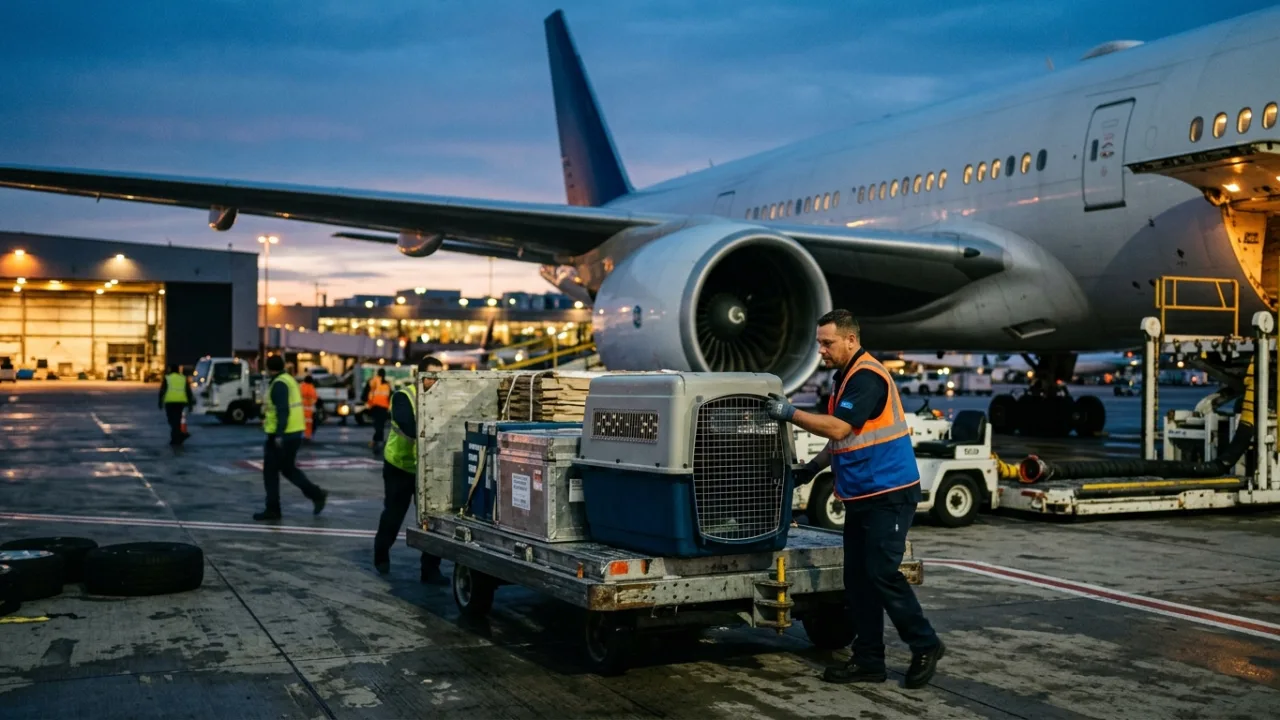
Qatar Airways follows a broadly similar model through Qatar Airways Cargo, its dedicated freight division.
- Booking: Also arranged through cargo agents or pet shippers, not the regular passenger booking flow.
- Hub considerations: Doha’s Hamad International Airport has dedicated animal handling facilities, but connection times and heat exposure on the tarmac during transfers are still worth asking about directly.
- Breed and health screening: Similar caution applies to snub-nosed breeds and dogs with underlying health conditions that could be aggravated by the stress of air travel.
- Seasonal embargoes: Qatar Airways Cargo, like most carriers flying into hot climates, pauses live animal acceptance during periods of extreme heat at origin, transit, or destination airports.
Emirates vs. Qatar Airways: Quick Comparison
| Factor | Emirates (SkyCargo) | Qatar Airways (Cargo) |
|---|---|---|
| Cabin travel for dogs | Not permitted | Not permitted |
| Booking method | Cargo agent / pet relocation company | Cargo agent / pet relocation company |
| Hub airport | Dubai (DXB) | Doha (DOH) |
| Brachycephalic breeds | Restricted / case-by-case | Restricted / case-by-case |
| Heat embargoes | Yes, seasonal | Yes, seasonal |
| Import permit required before booking | Generally yes | Generally yes |
| Service dogs for disabled passengers | Case-by-case exceptions may apply | Case-by-case exceptions may apply |
Because policies and embargo windows change from season to season and even route to route, always confirm current terms directly with the airline’s cargo division or your pet relocation agent before finalizing travel dates.
Entry Rules by Country

Getting your dog onto a plane is only half the challenge — you also need to satisfy the destination country’s import requirements. Below is a general overview of what’s commonly required across major Gulf destinations. Requirements do change, so verify specifics with the relevant ministry or embassy before you travel.
United Arab Emirates (Dubai, Abu Dhabi, and beyond)
- Import permit: Required in advance from the UAE’s Ministry of Climate Change and Environment (MOCCAE), applied for online.
- Microchip: ISO 11784/11785-compliant microchip implanted before rabies vaccination for the vaccination to count (see: ISO-compliant microchip requirements).
- Rabies vaccination: Must be current, administered at least 21 days before travel (and not too close to arrival, depending on vaccine type).
- Health certificate: Issued by an accredited veterinarian and often endorsed by the relevant government veterinary authority shortly before departure.
- Breed restrictions: The UAE restricts import of certain breeds classified as dangerous, which commonly includes breeds like Pit Bull Terriers and Rottweilers (see: breed bans vary wildly by country) on many restricted lists — check the current list before committing to travel with a restricted breed.
- Age minimum: Puppies typically need to be old enough to have completed their rabies vaccination course before travel is permitted.
Qatar
- Import permit: Required from Qatar’s Ministry of Municipality before your dog can be shipped.
- Breed restrictions: Qatar has historically restricted import of breeds it classifies as dangerous or aggressive — this list has changed over time, so confirm current status for your specific breed well ahead of booking.
- Vaccination and microchip: Similar to UAE requirements — ISO-compliant microchip, current rabies vaccination, and a veterinary health certificate.
- Quarantine: Depending on your dog’s origin country and documentation completeness, a period of quarantine on arrival is possible, so ask specifically whether your situation qualifies for direct release.
Saudi Arabia
- Import permit: Required in advance, along with vaccination records and a health certificate.
- Additional documentation: Saudi Arabia has, at various times, required additional lab testing or specific certification depending on the country of origin — a pet relocation specialist familiar with current Saudi requirements is genuinely worth the fee here.
- Sponsorship considerations: If you’re relocating for work, your employer or sponsor may need to be involved in parts of the import process.
Other Gulf Destinations (Oman, Bahrain, Kuwait)
These countries generally follow a similar pattern — advance import permit, microchip, rabies vaccination, and a veterinary health certificate — but specific waiting periods, quarantine policies, and breed rules vary. Because requirements shift and enforcement can differ by airport, always confirm directly with the destination country’s official veterinary or agriculture ministry, ideally in writing, before finalizing flights.
The Rabies Titer Test: When You Need It
Depending on your dog’s country of origin and its rabies-free or rabies-controlled status, some Gulf countries require a rabies antibody titer test (commonly called a FAVN test) performed at an approved laboratory, with results submitted a set number of days before travel.
This test can take weeks to process, so it’s one of the first things to check when you start planning — leaving it until the last month is one of the most common reasons pet relocations get delayed.
Common Mistakes to Avoid
- Booking passenger flights before confirming cargo space. Cargo capacity for live animals is limited per flight — booking your own ticket first and assuming your dog will simply follow can leave you scrambling for alternative dates.
- Underestimating permit processing time. Import permits, titer tests, and health certificate endorsements can each take anywhere from days to several weeks. Start the paperwork at least 6-8 weeks before your intended travel date.
- Ignoring seasonal heat embargoes. If you’re flexible, avoid booking dog travel during the hottest months if possible — extreme heat embargoes can force last-minute rebooking.
- Assuming all breeds are welcome. Check both the airline’s breed restrictions (often focused on brachycephalic dogs) and the destination country’s banned breed list before you get emotionally or financially invested in a specific travel date.
- Using a crate that doesn’t meet IATA standards. Airlines will refuse animals in crates that are too small, poorly ventilated, or missing required labeling and water access features.
- Forgetting the return trip. If this is a temporary posting, research the entry rules for wherever you’ll eventually return to as well — some countries have stricter re-entry requirements than the destination itself.
Practical Tips for a Smoother Journey
1. Talk to a Pet Relocation Specialist
For international moves involving cargo shipment and multiple layers of paperwork, a reputable pet relocation company can coordinate the import permit, book cargo space, arrange the IATA-compliant crate, and handle documentation checks. It costs more than doing it yourself, but it significantly reduces the risk of a shipment being rejected at the airport.
2. Get Your Dog Crate-Trained Early
Cargo travel means your dog spends the flight — and time before and after it — inside the crate without you present. Start crate training months in advance so the crate feels familiar and safe rather than frightening on travel day.
3. Schedule a Pre-Travel Vet Visit
Book a veterinary exam close to your travel date to confirm your dog is fit to fly, update any vaccinations that are close to lapsing, and get the health certificate signed within the validity window required by your destination.
4. Choose Direct Routes When Possible
Fewer connections mean less time your dog spends being moved between aircraft and holding areas, and less exposure to tarmac heat during transfers.
5. Plan for Arrival Logistics
Find out in advance whether you personally need to be present at the cargo terminal to clear your dog through customs, and how long that process typically takes. Arriving unprepared for a multi-hour customs and cargo release process is a common source of stress.
Trade-Offs and Limitations Worth Knowing
There’s no way around the reality that flying a dog to the Middle East on Emirates or Qatar Airways involves more logistics, more cost, and more advance planning than flying a dog domestically in many other regions. Cargo shipment fees, permit fees, lab testing, and relocation specialist charges add up.
Some pet owners choose to delay their own travel by a few weeks so their dog’s paperwork and flight can be properly arranged, rather than rushing everything to match a single travel date. Others decide that, given breed restrictions or a dog’s anxiety with travel, a Gulf posting isn’t the right fit for their pet at all — and that’s a legitimate, responsible decision too, not a failure.
Expert Insight
Pet relocation professionals who work with these routes regularly tend to emphasize the same two things: start early, and get requirements in writing directly from the destination country’s veterinary authority rather than relying solely on general online guidance, since rules can be updated with little public notice.
Airlines, for their part, prioritize animal welfare seriously in their cargo operations — the temperature-controlled hold environment and IATA crate standards exist specifically to protect animals in transit — but that same caution is exactly why embargoes and restrictions exist, and why they’re enforced strictly rather than treated as guidelines.
Conclusion
Flying to the Middle East with your dog is absolutely doable — thousands of pet owners relocate to Dubai, Doha, Riyadh, and beyond every year with their dogs in tow. But it’s a process, not a booking.
Emirates and Qatar Airways both route pets through cargo divisions rather than cabin travel, each Gulf destination has its own import permit and documentation requirements, and breed restrictions plus seasonal heat embargoes can reshape your timeline if you’re not prepared for them.
Start the paperwork early, confirm current rules directly with official sources, and lean on a pet relocation specialist if your schedule or your dog’s breed adds complexity. The extra planning is worth it for a safe, stress-free arrival for your dog.
Need help mapping out your specific route? Talk to your vet about your dog’s health certificate timeline, contact the destination country’s veterinary authority for current import rules, and reach out to Emirates SkyCargo or Qatar Airways Cargo directly to confirm space and current breed policies before you book anything else.
Frequently Asked Questions
Can dogs fly in the cabin with Emirates or Qatar Airways?
No. Neither Emirates nor Qatar Airways allows dogs in the passenger cabin on standard flights. Dogs travel as manifest cargo through Emirates SkyCargo or Qatar Airways Cargo, in a pressurized, temperature-controlled hold, booked separately from your own passenger ticket.
How far in advance do I need to apply for a dog import permit to the UAE?
Start the process at least 6-8 weeks before travel. You’ll need an import permit from the UAE’s Ministry of Climate Change and Environment, a valid microchip, current rabies vaccination, and a veterinary health certificate issued shortly before departure. Processing times can vary, so applying early avoids last-minute delays.
Are certain dog breeds banned from entering Gulf countries?
Yes. Several Gulf countries, including the UAE and Qatar, maintain restricted or banned breed lists that commonly include breeds classified as dangerous, such as Pit Bull Terriers and Rottweilers. These lists can change, so confirm your specific breed’s status with the destination country before booking travel.
Why do airlines refuse to fly dogs during summer months in the Middle East?
Emirates, Qatar Airways, and most other carriers impose seasonal heat embargoes on live animal cargo when ground temperatures at departure, transit, or arrival airports become dangerously high. This protects animals from heat stress during loading, unloading, and tarmac time, and it can force rescheduling if you’re traveling between roughly May and September.
Do I need a rabies titer test to bring my dog into Qatar or the UAE?
It depends on your dog’s country of origin and its rabies status classification. Some countries require a rabies antibody titer test (FAVN test) completed at an approved lab well before travel, since results can take weeks to process. Check current requirements with the destination country’s veterinary authority early in your planning.
Can I book my dog’s cargo flight on the same plane as my passenger flight?
Not always. Because live animal cargo space is limited per flight, your dog may travel on a different flight or even a different day than you. It’s best to confirm cargo space availability before finalizing your own passenger ticket dates.
Do brachycephalic (flat-faced) dogs like Pugs or Bulldogs face extra restrictions?
Yes. Both Emirates and Qatar Airways apply additional restrictions to snub-nosed breeds because of their higher risk of respiratory distress during air travel, and some routes may refuse them outright. Check directly with the cargo division before assuming your brachycephalic dog can travel.
Should I use a pet relocation company instead of arranging everything myself?
For international moves to the Middle East, a pet relocation specialist can be worth the added cost because they coordinate import permits, cargo booking, IATA-compliant crates, and documentation checks in one process. This significantly reduces the risk of your dog’s shipment being rejected or delayed due to a paperwork issue.