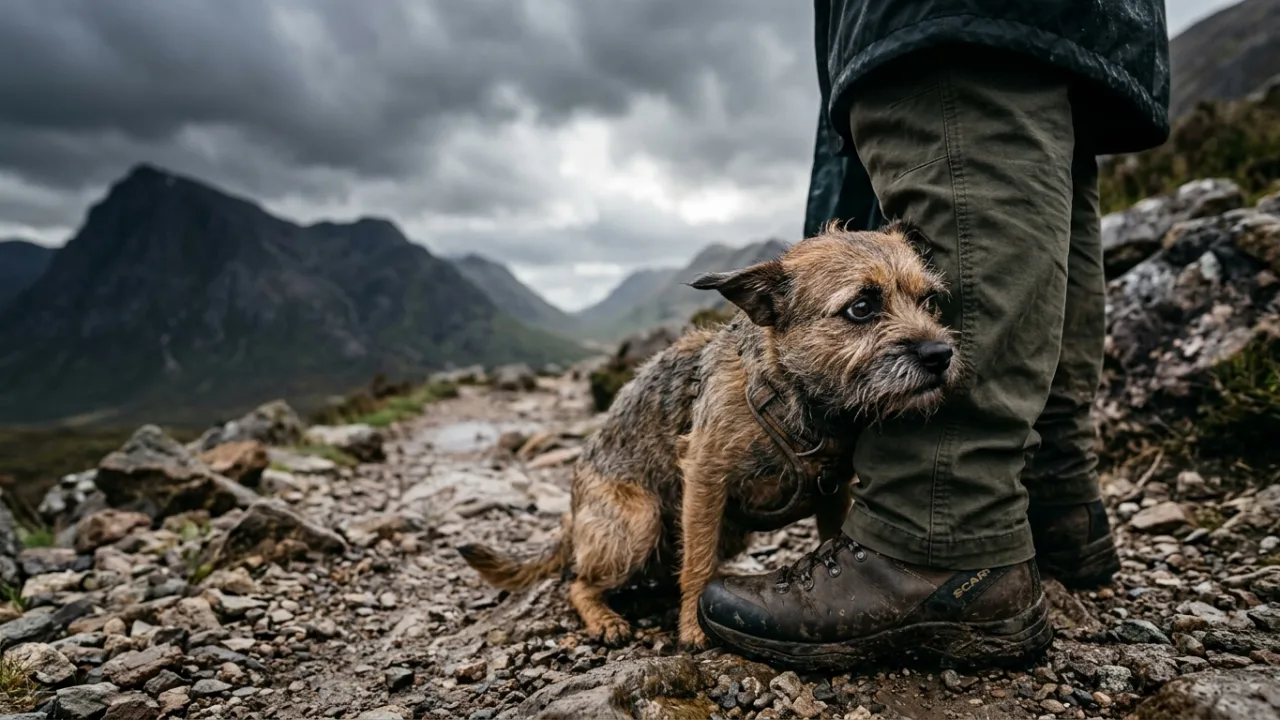
You’re forty minutes from the summit, the wind just shifted, and the cumulus tower that looked harmless an hour ago now has a dark, flattening anvil top. Your dog stops walking, ears pinned, and refuses to go another step forward. Somewhere behind that ridge, thunder just cracked. Every hiking guide you’ve read covers what a human should do in this moment — crouch, drop metal, get low — but almost none of them tell you what to do with the leash in your hand, the dog at your feet, or the forty pounds of muscle and panic that may decide to bolt toward the cliff edge instead of away from it.
- Use the flash-to-bang rule (5 seconds = 1 mile) and the 30/30/30 rule to decide when to move — but on exposed ridgelines, start descending well before the 30-second threshold because there’s no shelter to run to.
- Never let a dog off-leash near cliff edges during a storm, but do keep the leash short, non-metal, and away from your body during a lightning crouch; unclip only if a metal buckle is the sole conductive risk and you can maintain physical control another way.
- Small dogs are not inherently safer from lightning because of height — ground current and side flash affect anything touching the earth, regardless of size.
- Descend at least 100 vertical feet or further from the ridge crest into a depression, saddle, or below treeline whenever possible; higher and more exposed always means higher risk.
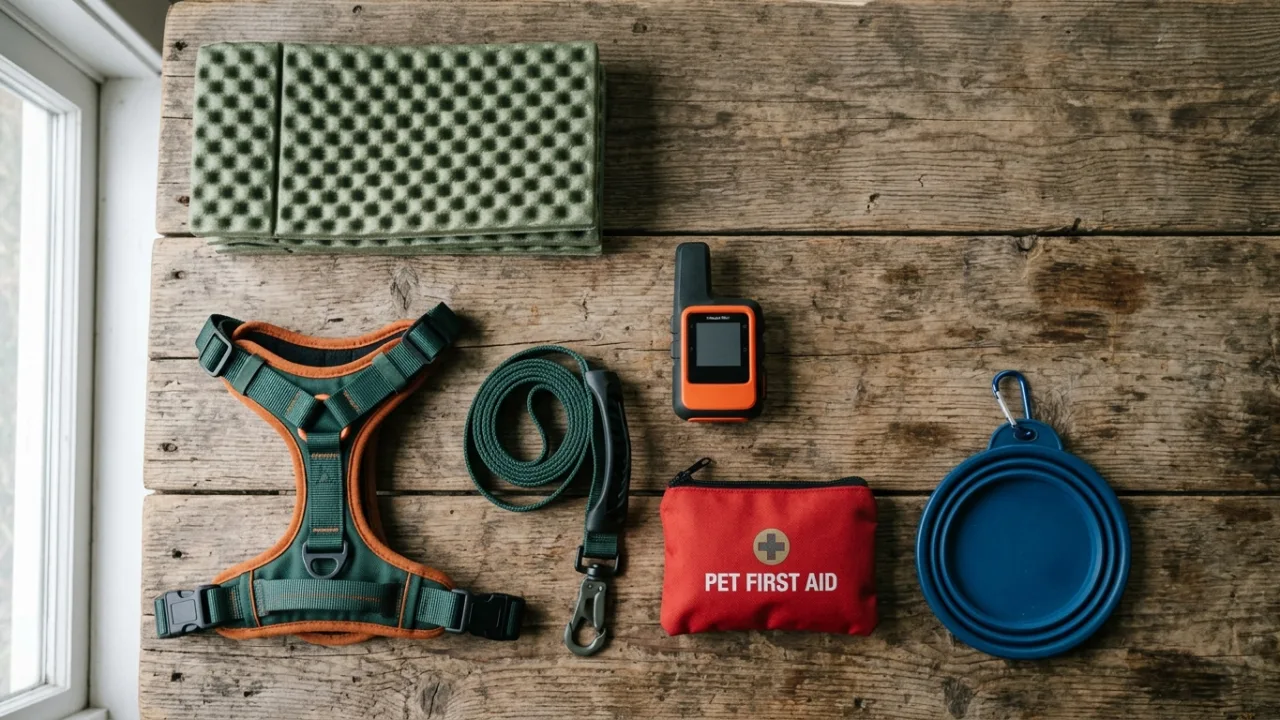
- Carry a lightweight foam pad for your dog to crouch on, just as you would insulate yourself, and pack a dog-specific first-aid kit plus a satellite communicator for any ridge route with no cell coverage.
- After any nearby strike, check your dog for burns, singed fur, disorientation, limping, or breathing changes — and don’t assume no visible injury means no injury.
Why Ridgelines Turn an Ordinary Storm Into an Emergency
Ridgelines and summits are lightning magnets for a simple reason: they’re the tallest, most conductive points around, and they often stick up into the exact altitude band where developing thunderstorms build their charge. Add in exposed rock, minimal vegetation, and narrow trails with steep drop-offs on both sides, and you’ve created terrain where the storm hazard and the fall hazard compound each other. This is exactly why lightning on exposed ridgelines requires a dog-specific evacuation protocol — the standard human-only advice doesn’t account for a leashed animal, a bolting risk near a cliff edge, or a companion who can’t understand why you’re suddenly crouching in the rain.
Three terrain-specific dangers matter most above treeline:
- Direct strikes on the highest point of exposed rock or on a hiker/dog who is the tallest object around.
- Ground current (step potential) — after a strike hits nearby rock, electricity spreads outward through the ground and can travel up through four legs or two just as easily, sometimes more dangerously for a four-legged animal with a wider stance across the current path.
- Side flash — a strike jumps from a nearby tall object (a boulder, a solo tree, even a hiker standing upright) to a person or dog nearby.
Open rock slabs and exposed summits carry the highest risk. Saddles and shallow depressions are safer than the crest but still exposed. Gullies can be safer from direct strikes but bring flash-flood risk in the same storm. True treeline, with evenly-spaced smaller trees, is the actual safety benchmark you’re aiming for — not just any hindfoot lower elevation.
Ridgeline Hazard Checklist by Terrain Feature
| Terrain Feature | Lightning Risk | Go / No-Go Guidance |
|---|---|---|
| Open summit or exposed rock slab | Very high — tallest point, direct strike risk | No-go once thunder is audible; retreat immediately |
| Narrow knife-edge ridge | Very high — no retreat options, fall hazard compounds storm hazard | No-go if storm cells visible within 10 miles |
| Saddle or shallow depression below crest | Moderate — lower than surrounding terrain but still open | Acceptable short-term shelter, not a final stop |
| Boulder field away from tallest rocks | Moderate — avoid isolated tall boulders and overhangs | Usable in transit, not for extended shelter |
| Gully or drainage | Lower lightning risk, higher flash-flood risk | Situational go — check for water buildup |
| Even-aged treeline (uniform tree height) | Lowest practical backcountry risk | Go — this is your target zone |
Reading the Sky Before You Ever Step on the Ridge
The best dog-specific evacuation protocol is the one you never have to use, because you turned around before committing to exposure. (see: knowing when to turn back) Afternoon thunderstorms are the classic alpine pattern in mountain ranges across the U.S. — heat builds through the morning, moist air rises, and by early-to-mid afternoon, towering cumulus clouds can develop into full thunderstorms within an hour. That’s why alpine guides almost universally recommend starting ridge and summit routes at first light and being off exposed terrain by noon or early afternoon, well before the typical build-up window.
Before you leave the trailhead, build a short pre-hike weather check into your routine:
- Check a mountain-specific or point forecast (not just the nearest town’s forecast) for thunderstorm probability and timing.
- Note the freezing level and any convective outlook — high instability numbers mean faster-building storms.
- Set a hard turnaround time based on the forecast, not on how close you are to the summit.
- Identify your bail-out points on the map in advance — the nearest saddle, gully, or treeline patch below the ridge — so you’re not searching for one while thunder is already rolling.
- Tell someone your route and turnaround time, including that you’re traveling with a dog, in case a search-and-rescue callout is ever needed.
On the trail, watch for building cumulonimbus towers, darkening anvil tops, a sudden drop in temperature, gusty shifting wind, and — this one is easy to miss — a faint metallic or ozone smell and hair or fur standing on end, which can signal an imminent strike. If your dog’s fur is visibly standing up or you feel static on your skin, you are already in a danger zone and need to move immediately, not in five minutes.
Do Dogs Sense Storms Before We Do?
Many hikers report that their dog seems to know a storm is coming before any human cue is obvious — pacing, panting, trying to turn back, tail tucking, or refusing to continue forward. Dogs have much more sensitive hearing than we do and may detect distant thunder or the low-frequency rumble of a developing storm system well before it’s audible to a person, and some researchers believe dogs may also react to rapid barometric pressure changes or the static electric field building in the air. None of this is precisely measurable in the field, but the practical takeaway is simple and worth trusting: if your dog is showing sudden, unexplained anxiety on an exposed ridge — refusing to move, whining, pressing against your legs — treat it as an early warning sign, not a behavior problem to correct. Reassess the sky immediately and consider turning back even if you don’t yet hear thunder yourself.
The 30/30/30 Rule — And Why It Gets Complicated Above Treeline
The 30/30/30 rule is the backbone of lightning safety guidance: if you see lightning and hear the thunder within 30 seconds, the storm is close enough to be dangerous, so you should seek shelter, and you should wait 30 minutes after the last thunderclap before resuming activity. It’s built around the idea that lightning can strike up to roughly 10 miles ahead of a storm’s leading edge — meaning a storm can threaten you even while the sky above you still looks clear.
The problem on an exposed ridgeline is the middle third of that rule: seek shelter. There often isn’t any. This is where the dog-specific evacuation protocol has to adapt the general rule into an action plan:
- First 30 (see-to-hear): The instant you count 30 seconds or less between flash and bang, stop debating the summit and start descending toward your pre-identified bail-out point. Don’t wait for a second confirmation.
- Second 30 (the shelter gap): Since true shelter may be 20+ minutes away, treat every minute of descent as risk-reduction, not risk-elimination. Moving off the highest point immediately, even partway, meaningfully lowers your exposure compared to standing still on the crest.
- Third 30 (the wait): Once you and your dog are off the ridge and in a lower depression or treeline, don’t move again until 30 minutes have passed since the last thunder. Storms can double back, and a second strike zone can form right where you just were.
Flash-to-Bang Distance Chart
| Seconds Between Flash and Thunder | Approximate Distance | Action |
|---|---|---|
| 30+ seconds | Roughly 6 miles or more | Monitor closely, begin moving toward lower ground as a precaution |
| 20-30 seconds | Roughly 4-6 miles | Actively descend toward your bail-out point now |
| 10-20 seconds | Roughly 2-4 miles | Storm is close — prioritize speed and dog control over distance covered |
| Under 10 seconds | Under 2 miles | High danger zone — get off any exposed rock immediately and assume lightning position if no lower ground is reachable |
| Flash and bang nearly simultaneous | Under half a mile | Critical danger — the storm is essentially overhead |
A rough industry rule of thumb is that a thunderstorm cell can move across several miles of alpine terrain in well under an hour, and mountain storms are notorious for building and arriving faster than they appear to from a distance because ridgelines and valleys distort both sightlines and sound. Don’t use how far away a storm looks as your only gauge — use the count.
Step-by-Step: A Ridge Descent Scenario Walkthrough
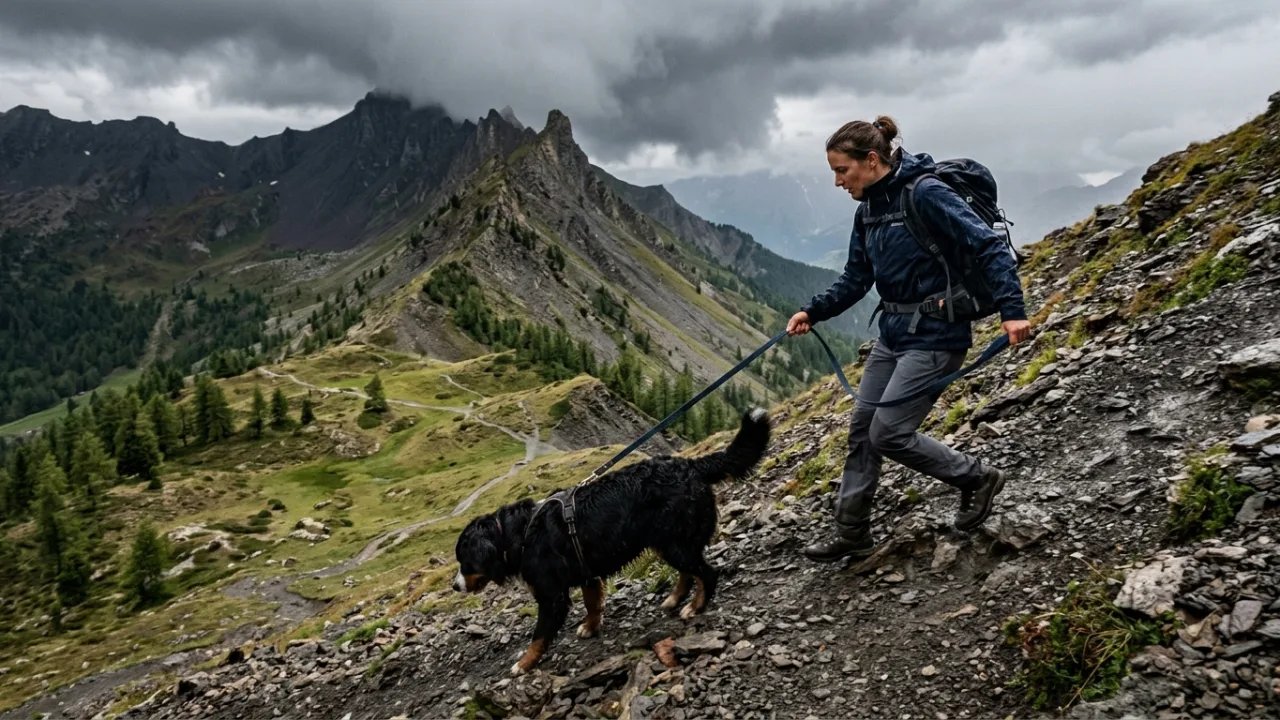
Picture this realistic sequence, because rehearsing it mentally before you’re ever in it is what actually makes a dog-specific evacuation protocol work under stress:
- Decision point 1 — cloud buildup spotted. You notice a cumulonimbus tower building over a nearby peak. Your dog is walking normally. Action: note the time, keep moving but start watching the sky every few minutes instead of only occasionally.
- Decision point 2 — dog behavior changes. Your dog starts panting heavily, won’t take treats, and keeps glancing backward. Action: stop, assess the sky again, and begin discussing a turnaround with your hiking partner even if thunder hasn’t started.
- Decision point 3 — first thunder heard. You count 25 seconds to the boom. Action: this is your trigger. Shorten the leash, identify the nearest lower ground on your map or memory, and start moving with purpose — not panic-sprinting, but a controlled, fast pace.
- Decision point 4 — descent underway. Rocks are uneven, your dog’s nails are slipping, thunder is now 15 seconds out. Action: switch from leash-guiding to carrying if your dog is small enough, or use a chest-height control hold if large, and prioritize the most stable line of retreat over the fastest-looking one.
- Decision point 5 — reaching a saddle or treeline. You’ve dropped below the exposed crest into a stand of similar-height trees. Action: get your dog onto an insulated pad, crouch low yourselves, keep the leash slack near you but not looped around your body, and wait out the 30-minute window.
Carrying vs. Leash-Guiding a Dog During Rapid Descent
| Method | Best For | Pros | Cons |
|---|---|---|---|
| Carrying (arms or sling) | Small to medium dogs under roughly 25-30 lbs | Fastest control, prevents bolting, keeps dog off unstable rock | Slows your own footing and balance on technical terrain |
| Leash-guiding, shortened | Larger dogs and any dog on stable, wider trail sections | Preserves your own mobility and balance | Dog can still slip, panic, or pull toward edges |
| Front-clip harness with handle | Medium-large dogs on narrow but not knife-edge terrain | Gives you a physical lift/steady point without a full carry | Requires a harness rated for handler-assisted lifting |
| Dog carry pack/sling for descent | Injured dogs or very technical short sections | Frees both your hands for scrambling | Adds weight and bulk, needs practice before an emergency |
As a general rule, if you can physically and safely carry your dog and doing so measurably speeds your descent off exposed rock, do it. If carrying compromises your own footing on a knife-edge or scramble, a shortened, controlled leash with a firm walking pace is safer for both of you than an awkward carry that risks a fall for either one of you.
Dog Size and Breed Considerations on Exposed Terrain
| Dog Type | Carry Feasibility | Leash Control Notes | Storm-Specific Risk |
|---|---|---|---|
| Small breed (under 20 lbs) | Easily carried in arms or a sling for rapid descent | Light pulling force, easy to control on narrow trail | Height does not reduce lightning risk — ground current and side flash affect any size |
| Medium breed (20-50 lbs) | Short-distance carry possible but tiring | Moderate pull strength; needs a sturdy harness for narrow ledges | Similar overall risk profile to a crouched human |
| Large breed (50+ lbs) | Not practically carryable except in short emergency lifts | Strong pull risk near edges when panicked; needs firm, close leash control | Bolting risk is the primary concern more than lightning-specific vulnerability |
| Brachiocephalic breeds (bulldogs, pugs, etc.) | Often need carrying anyway due to limited endurance | Very limited stamina for forced fast descent | High risk of panic-induced breathing distress during stress and altitude combined |
One myth worth retiring: a dog’s lower height does not meaningfully reduce lightning risk the way people sometimes assume. Lightning current spreading through the ground (step potential) actually poses a comparable or arguably distinct risk to four-legged animals because of the wider stance between front and back feet along the current’s path. A shorter body is not a safety feature in a lightning event — proximity to the strike point, the ground’s conductivity, and whether you’re both off the highest terrain matter far more than an animal’s height.
The Lightning Position: Human vs. Dog
If you’re caught mid-ridge with genuinely no lower ground reachable before the storm arrives, the classic human lightning position is: crouch low on the balls of your feet, feet together, minimize contact points with the ground, and get off of and away from a metal-framed pack. A dog cannot be taught to voluntarily assume this position, so the protocol has to be adapted.
| Element | Human Lightning Position | Dog Handling Equivalent |
|---|---|---|
| Body posture | Crouch on balls of feet, feet together, head down | Encourage the dog to lie down or crouch low and still, ideally on an insulated pad |
| Ground contact | Minimize points touching the earth | Cannot be reduced (four paws), so insulation matters more than posture |
| Spacing from others | Spread out 15+ feet from other hikers | Keep the dog within arm’s reach for control, but off to the side, not pressed against your body |
| Metal gear | Drop and distance trekking poles, tent poles, metal-frame packs | Remove or distance metal-buckle collars/leash clips if feasible without losing control |
| Insulation | Crouch on a pack or foam pad, not directly on wet rock | Place the dog on its own foam pad or a folded dry bag |
Should You Unclip the Leash? The Straight Answer
This is one of the most common points of confusion, so let’s be direct: do not simply unclip your dog and let it loose near a cliff edge during a lightning event, because the fall risk from a panicked, off-leash dog on exposed terrain is generally a more immediate danger than the marginal difference a metal clip makes to strike probability. The safer approach is to switch to a leash and collar/harness setup with as little exposed metal as possible in advance of storm season, keep a few feet of slack between you and the dog rather than wrapping the leash around your hand or body, and avoid holding a metal-clipped leash directly against your torso during a crouch. If your only leash and collar are metal-heavy, the fall and bolting risk of going leash-free almost always outweighs the small incremental conductivity risk of the clip itself.
Metal Gear: What to Drop or Distance
Trekking poles, tent poles, and metal-frame dog carry packs are the classic gear worth putting down and stepping several feet away from during an active lightning threat — not because metal ‘attracts’ lightning from a distance the way movies suggest, but because holding a tall conductive object increases your effective height and creates a more direct path if a strike does occur nearby. Practical steps:
- Collapse and lay down trekking poles a few feet away from where you and your dog are sheltering.
- Remove metal-frame dog packs and set them aside rather than keeping them on the dog’s back.
- Umbrellas with metal ribs should be closed and set down, not held overhead.
- Choose non-metal or minimal-metal collars, harnesses, and carabiner-style leash clips as your standard alpine hiking setup during storm season, simply to reduce one more variable.
Insulated Pads: Yes, for Your Dog Too
Human lightning guidance recommends crouching on an insulating layer — a foam pad or empty pack — rather than directly on wet rock, since dry insulation reduces (though never eliminates) some ground-current exposure. The same logic applies to a dog. A lightweight foam sit pad, a folded dry bag, or even a rolled rain jacket placed under your dog while it’s crouched or lying down during a wait-out period is a simple, low-weight addition to your pack that directly supports this protocol. It won’t make you invulnerable — nothing does above treeline in an active storm — but it’s a reasonable, low-cost precaution worth carrying specifically for ridge routes.
Handling a Panicking or Bolting Dog on a Narrow Trail
Thunder is loud, sudden, and — from a dog’s perspective — completely unpredictable, which is exactly the combination that triggers flight responses. (see: reliable trail recall training) On a wide trail this is a minor annoyance; on a narrow ridge with a drop-off, it’s the single most dangerous moment of the entire scenario.
Correct handling
- Shorten the leash well before thunder starts, the moment you notice storm buildup, so you’re not scrambling to grab slack during a startle response.
- Position yourself on the downhill or cliff side of the dog when possible, so your body is the barrier between the dog and the edge, not the other way around.
- Use a calm, low, familiar verbal cue rather than a sharp correction — a startled dog responds worse to added tension.
- If your dog freezes and refuses to move, don’t drag it. Kneel down, physically support its body, and use a favorite treat or firm gentle lift to restart movement rather than forcing a pull against the collar.
Incorrect handling (and why it fails)
- Letting the leash go slack ‘just in case’ the dog bolts — this removes your only physical control at the worst possible moment.
- Yelling or yanking hard on the leash when thunder cracks — this adds a second stressor on top of the storm itself and often increases panic rather than reducing it.
- Standing on the exposed side while the dog is on the cliff side, reversing the protective positioning.
How Far Below the Ridge Is Actually Safe Enough?
There’s no single magic number, but a reasonable field guideline used by many backcountry educators is to aim for at least 100 vertical feet of descent below the ridge crest, combined with moving into a depression, saddle, or treeline rather than just dropping elevation on another exposed slope. Elevation drop alone isn’t the goal — reducing your relative height compared to the surrounding terrain is. A saddle 50 feet below the crest but surrounded by higher terrain on both sides can be meaningfully safer than a spot 150 feet lower on an open, still-exposed slope. When in doubt, prioritize getting into or near actual treeline over hitting a specific number of feet.
Groups With Multiple Dogs: Spread Out or Stay Together?
For humans, standard lightning guidance says to spread group members out by at least 15-20 feet so a single strike can’t take out the entire group at once. The same logic reasonably extends to multiple dogs and handlers: rather than clustering everyone (and every dog) in one tight huddle, spread handler-and-dog pairs out at safe intervals along a lower, less exposed section, while keeping each dog under its own handler’s direct control. Avoid tying multiple dogs together or looping leashes between people, since that creates one connected conductive and physical hazard instead of several smaller, more manageable ones.
If Your Dog Is Struck: Field First Aid
Veterinary data specific to lightning strikes in dogs is genuinely limited — there isn’t a robust body of published field statistics the way there is for human lightning injuries, and this article won’t invent numbers that don’t exist. What backcountry-oriented veterinary guidance does consistently emphasize is recognizing the signs and acting fast:
- Signs of a possible strike: singed or burned fur (often at entry/exit points like paws, ears, or tail), unconsciousness, disorientation, stumbling or an abnormal gait, dilated pupils, irregular or absent breathing, or sudden collapse.
- Immediate steps: check for breathing and a pulse; if absent, dog-specific CPR should be started by anyone trained to perform it while help is summoned. Move the dog away from the exposed area if it’s safe to do so, keep it warm and still, and check for burns needing basic wound coverage.
- Do not delay evacuation waiting to see if symptoms resolve — disorientation and shock can worsen over the following hours even if the dog initially seems to be walking normally.
- Call for help immediately using a satellite communicator or PLB if you have no cell signal, and give your GPS coordinates, the dog’s condition, and your planned movement toward the trailhead.
If your dog was near a strike but shows no obvious injury, still monitor closely for the next 24-48 hours for delayed limping, disorientation, appetite loss, or unusual lethargy once you’re back at the trailhead or in camp, and contact a veterinarian promptly if anything seems off, describing the lightning exposure specifically.
Post-Storm Reassessment Before Continuing
Once the 30-minute post-thunder window has passed, resist the urge to immediately push on toward the summit just because the sky cleared. Run a quick check on your dog first: watch its gait for any hesitation or limping, check paws and ears for burns, note whether it’s eating or drinking normally, and pay attention to lingering anxiety or reluctance to keep hiking. A dog that seems ‘off’ after a storm event — even without an obvious strike — deserves a cautious, shorter remaining route or a full turnaround rather than continued exposure. This is also a good moment to check the wider forecast again; a cleared storm cell is frequently followed by a second one later the same afternoon in classic mountain weather patterns.
Should You Turn Back Before the Summit?
If thunderstorms are forecast for your hiking window at all, the honest answer is yes, plan to turn back before reaching an exposed summit, even if you’re objectively close. Summit fever is a well-documented factor in mountain accidents generally, and adding a dog to the equation raises the stakes further, since your dog has no ability to independently assess risk or advocate for a turnaround. Setting a hard, non-negotiable turnaround time before you start — and actually honoring it even 200 feet from the top — is one of the single most effective ways to avoid ever needing the rest of this protocol.
Comparing Backcountry Reality to Standard Shelter Guidance
Standard public safety guidance (the kind you’d find from national weather and health agencies) consistently recommends getting inside a substantial building or hard-topped vehicle at the first sign of thunder, and treats open shelters, tents, and covered pavilions as inadequate. That guidance is entirely correct for its intended context — but it assumes a shelter or vehicle is reachable within minutes, which is rarely true on a remote alpine ridge. Similarly, established pet-evacuation advice from animal welfare organizations focuses heavily on home and disaster-scenario evacuation: carriers, leashes, familiar bedding, and calm crate-training. That advice is genuinely useful for building general calm-handling habits in your dog, but it doesn’t address the specific mechanics of a rapid, controlled descent on exposed technical rock — which is why a ridgeline-specific protocol has to blend general lightning safety, general pet evacuation principles, and mountain-specific terrain judgment into one coherent plan.
What Lightning Statistics Actually Tell Us
| Category | What’s Known | What’s Not Well Documented |
|---|---|---|
| General population lightning fatalities | Weather agencies track annual lightning fatality and injury counts nationally each year | Fatalities are not consistently broken down specifically by hiking/outdoor recreation activity in public summaries |
| Elevation and terrain correlation | Weather agencies and researchers broadly note that mountainous and elevated terrain sees disproportionately high lightning activity compared to lowland areas | Precise ridge-versus-valley strike density for specific mountain ranges isn’t something we’ll cite a specific figure for here |
| Animal/pet lightning incidents | Occasional individual case reports exist | There is no robust, centralized dataset tracking canine lightning strikes during hikes; treat any such number you see elsewhere with skepticism |
| Storm movement speed | Alpine thunderstorms are widely recognized by mountain guides as capable of building and arriving faster than they appear to from a distance | Exact average crossing times vary too much by region and storm type to state as one general statistic |
We’re intentionally not inventing precise percentages or fatality figures for dogs here, because that data largely doesn’t exist in a citable, reliable form. The honest and genuinely useful takeaway is this: the actual numeric odds of your specific dog being struck on a specific hike are low, but the consequences are severe enough, and the mitigation steps simple enough, that the precaution is worth taking regardless of exact probability.
Pre-Hike Ridge/Alpine Lightning Risk Checklist
- Checked a point forecast specifically for the ridge/summit elevation, not just the trailhead town
- Identified a hard turnaround time based on forecasted storm timing
- Marked at least one bail-out point (saddle, gully, treeline) on the map before departure
- Confirmed non-metal or minimal-metal collar, harness, and leash clip for the dog
- Packed an insulated pad, dog first-aid basics, and a satellite communicator or PLB
- Shared route and turnaround plan with someone off-trail, noting a dog is along
On-Trail Abort Checklist
- Thunder heard within 30 seconds of a visible flash
- Cumulonimbus towers building or darkening rapidly nearby
- Sudden static feeling, hair/fur standing on end, or a metallic smell in the air
- Dog showing sudden, unexplained fear behavior with no other trigger
- Wind shifting suddenly or a rapid temperature drop
Dog-Specific Emergency Kit for Alpine Storm Contingencies
- Lightweight foam sit pad or extra dry bag for insulation
- Backup leash and non-metal collar or harness
- Basic pet first-aid kit (gauze, vet wrap, saline, tweezers, thermometer)
- A lightweight muzzle, only for safe handling of a panicking dog if it becomes prone to snapping under stress, never as a punishment tool
- A collapsible bowl and extra water, since stress and forced descent increase dehydration risk
Post-Lightning-Event Dog Health Check
- Check gait for limping, stumbling, or reluctance to bear weight
- Inspect paws, ears, and tail for singed fur or burn marks
- Watch breathing rate and effort for several minutes
- Note any disorientation, glazed eyes, or unusual behavior
- Monitor appetite and energy over the following 24-48 hours once back at the trailhead
Gear Worth Buying Before Storm Season
A few practical upgrades make this entire protocol easier to execute when it counts:
- Non-metal or minimal-hardware harness and collar for alpine and ridge routes specifically, even if you use a standard setup elsewhere.
- A compact dog carry sling or soft-frame carry pack rated for emergency short-distance carrying, tested on easy terrain before you ever need it in an emergency.
- A satellite communicator or personal locator beacon for any route with known cell dead zones — this single piece of gear is often the difference between a manageable emergency and a dangerous, drawn-out wait for help if you or your dog are injured miles from the trailhead.
- A pet-specific first-aid kit, kept separate from your own so it’s never accidentally left behind. (see: backcountry canine first-aid kit)
Troubleshooting Common Problems
My dog freezes and won’t move during the descent
Don’t force a pull against the collar. Kneel to their level, keep your voice calm and low, and either lift/carry them past the immediate obstacle or use a favorite high-value treat to restart forward motion. Panic on your end will transfer to the dog, so slow your own breathing first.
I’m caught mid-ridge with no lower ground reachable in time
Get as low and as far from the highest points as the terrain allows immediately, even a few feet can matter. Assume the human crouch position, keep your dog low beside you on an insulated pad if you have one, spread out from other hikers, and wait it out rather than continuing to move across exposed rock.
My dog is becoming aggressive or snapping from storm panic
Stress-induced snapping is a fear response, not dominance or disobedience. Give a few feet of space if the terrain allows, avoid direct eye contact and sudden movements, and use a muzzle only if you have one trained and fitted in advance, purely for safe handling, not correction.
My dog shows delayed symptoms hours after we’re back at camp
Limping, disorientation, or unusual lethargy that appears hours after a nearby strike or a stressful storm event should be treated seriously. Contact a veterinarian, describe the lightning exposure specifically, and don’t assume a delayed symptom is unrelated just because time has passed.
We have no cell signal and need help
This is exactly the scenario a satellite communicator or PLB is designed for. Trigger your device’s SOS or messaging function, provide GPS coordinates, describe the injury (human or dog) clearly, and stay as sheltered and low as conditions allow while awaiting a response.
What Backcountry Professionals Generally Emphasize
Wilderness veterinary guidance consistently stresses that early recognition matters more than any specific field treatment — the sooner you identify burns, disorientation, or breathing changes and start evacuation, the better the outcome, since backcountry field treatment options for a dog are genuinely limited compared to a clinic setting. Search-and-rescue teams who respond to alpine incidents routinely point to summit fever and delayed turnaround decisions, not lack of gear, as the most common contributing factor in exposed-terrain emergencies, a pattern that applies just as much when a dog is part of the group. Meteorologists who study mountain weather note that ridges and peaks can locally intensify or even help trigger storm development because of how terrain forces air upward, which is part of why afternoon storms often seem to build ‘out of nowhere’ directly over a summit you’re approaching. And canine behaviorists generally advise that calm, confident handler behavior combined with distance from the trigger (in this case, exposure and thunder) does more to settle a stressed dog in the moment than any verbal correction — your own composure is functionally part of your dog’s safety gear.
Bringing It All Together
None of this is meant to make ridgeline hiking with your dog feel impossible — thousands of hikers and their dogs cross exposed alpine terrain safely every season. The goal of a dog-specific evacuation protocol isn’t to eliminate risk entirely, since above treeline that’s never fully possible, but to replace panic with a rehearsed sequence: watch the sky and your dog’s behavior, count flash-to-bang, commit to a turnaround time and a bail-out point before you’re forced to improvise one, keep your dog under short, controlled leash guidance or carry them if that’s genuinely faster and safer, insulate rather than expose, and reassess thoroughly once the storm passes. The dogs who handle these moments best are usually the ones whose humans stayed calm first.
If you’re planning ridge or alpine routes this season, take twenty minutes before your next trip to actually build your dog-specific storm kit, mark a real bail-out point on your map, and walk through this sequence out loud with your hiking partner. It’s a small investment that pays off exactly once — but that once is the day it matters most.
Frequently Asked Questions
What is the 30/30/30 rule and how does it apply above treeline with a dog?
The 30/30/30 rule says: if thunder follows lightning within 30 seconds, seek shelter, and wait 30 minutes after the last thunder before resuming activity. Above treeline, real shelter is often unavailable, so the rule becomes a trigger to immediately begin descending toward a pre-identified lower point with your dog rather than waiting to confirm the storm is truly close. Treat the first count under 30 seconds as your action signal, not a warning to monitor further.
What are the actual odds of a dog being struck by lightning on a hike?
There isn't reliable, centralized data specifically tracking canine lightning strikes during hikes, so any precise percentage you see cited elsewhere should be treated with caution. What is well established is that elevated, exposed terrain carries meaningfully higher lightning risk for anyone or anything on it, human or dog, which is why precautions are worth taking regardless of an unknown exact probability.
Does a dog's lower height make it more or less likely to be struck than a standing human?
Height alone doesn't meaningfully reduce risk. While a taller object is more likely to be the point of a direct strike, ground current spreading after a nearby strike can affect a dog through its four widely-spaced paws just as it affects a standing human. A dog's shorter stature is not a reliable safety advantage during a lightning event.
Can you use a dog's harness as an anchor point while sheltering, or should it be removed?
Avoid using a metal-buckle harness as a fixed anchor point pressed against your body during a lightning crouch, since this creates an unnecessary conductive connection. If your harness has minimal metal hardware, keeping it on for control is fine, but hold the leash loosely at a distance rather than wrapping it around your hand or torso, and set aside any metal-frame carry packs nearby rather than keeping them attached.
What is the fastest safe way to get a dog off a ridgeline when a storm rolls in?
For small to medium dogs, carrying them directly speeds descent and prevents bolting on unstable rock. For larger dogs, a shortened, firmly controlled leash combined with the handler positioned on the downhill or cliff side is generally faster and safer than attempting an awkward carry that compromises your own footing on technical terrain.
How do you perform first aid on a dog after a suspected lightning strike in the backcountry?
Check breathing and pulse first; begin dog CPR if trained and necessary while activating a satellite communicator for help. Move the dog away from further exposure if safe, keep it warm and still, and check for burns at paws, ears, or tail. Don't wait to see if symptoms resolve on their own — begin evacuation immediately since shock and disorientation can worsen over subsequent hours.
Should you turn back before reaching a summit if storms are forecast, even if you're close?
Yes. If thunderstorms are forecast for your hiking window, plan and commit to a turnaround time before departure, and honor it even a short distance from the summit. Adding a dog to the group increases the stakes, since your dog can't independently judge or communicate escalating risk the way a hiking partner can.
Is it safe to keep hiking with a dog once thunder is 10 seconds or more after the flash?
A 10-second-or-more gap still indicates a storm within roughly two miles, which is close enough to remain dangerous, especially on exposed terrain. It's safer to continue descending toward lower, less exposed ground rather than resuming a summit push, and to only fully resume normal hiking once you're 30 minutes past the last audible thunder.