You’re two miles in, the ridge is finally coming into view, and your dog — who was bounding up switchbacks twenty minutes ago — suddenly plants himself on the trail and won’t budge. The sky has that strange orange-brown haze you’ve been trying to ignore since the trailhead. Is this normal stubbornness, or is it smoke? Most dog owners have no real answer, because the AQI number on their phone (checked back at the car, with full bars) has nothing to say about what’s happening in their lungs right now, halfway up a switchback with no signal at all.
That gap — between a single pre-hike AQI check and the real-time, exertion-dependent reality of the trail — is where dogs get hurt during wildfire season. (see: knowing when to turn back) This guide closes that gap.
- AQI thresholds that are fine for a leash walk are often too high for a strenuous hike — sustained aerobic effort multiplies smoke exposure by increasing breathing rate and depth.
- General guideline: hike freely under AQI 50, use caution and shorten routes 51–100, avoid strenuous elevation gain 101–150, and skip hiking entirely above 150 — brachycephalic, senior, and cardiac/respiratory dogs should shave 20–50 points off every threshold.
- AQI readings from a valley trailhead can be very different from a ridge or summit during smoke inversions, so check elevation-specific forecasts, not just the town closest to the trail.
- When cell service is gone, use downloaded offline forecasts, a satellite communicator with weather feeds, or visual/smell-based estimation (reduced visibility of landmarks a known distance away is a reasonably reliable proxy).
- Persistent coughing, gagging, reluctance to continue, or gray/blue gums mean turn back immediately — don’t wait for the trailhead.
- Rinse ash from paws and coat after the hike, and watch for delayed coughing or lethargy for 24–48 hours even if your dog seemed fine on the trail.
Why a Hike Isn’t the Same as a Walk Around the Block
The single biggest thing missing from most wildfire-smoke advice is the distinction between casual movement and sustained aerobic exertion. When your dog trots around the neighborhood, she’s breathing at something close to resting rate. When she’s climbing a grade with a pack on or keeping pace with you up switchbacks, her respiratory rate and tidal volume both increase substantially — she’s pulling in far more air, far more often, and breathing more through an open mouth rather than filtering through the nose.
That matters enormously with wildfire smoke because the fine particulate matter that makes smoke dangerous (PM2.5, particles roughly 2.5 micrometers or smaller) bypasses a lot of the nose’s natural filtering when air moves quickly and mouth-breathing increases. A dog standing at a scenic overlook and a dog who just gained 800 feet of elevation in the same smoky air are not experiencing the same effective dose of particulate matter — even though the AQI reading is identical for both of them.
This is the core reason a single blanket AQI number (“under 100 is fine”) fails hikers. The right question isn’t just “what’s the AQI,” it’s “what’s the AQI relative to how hard my dog is about to work.” (see: matching a trail to your dog's fitness level)
AQI, Exertion Level, and Dog Risk: A Practical Reference Table
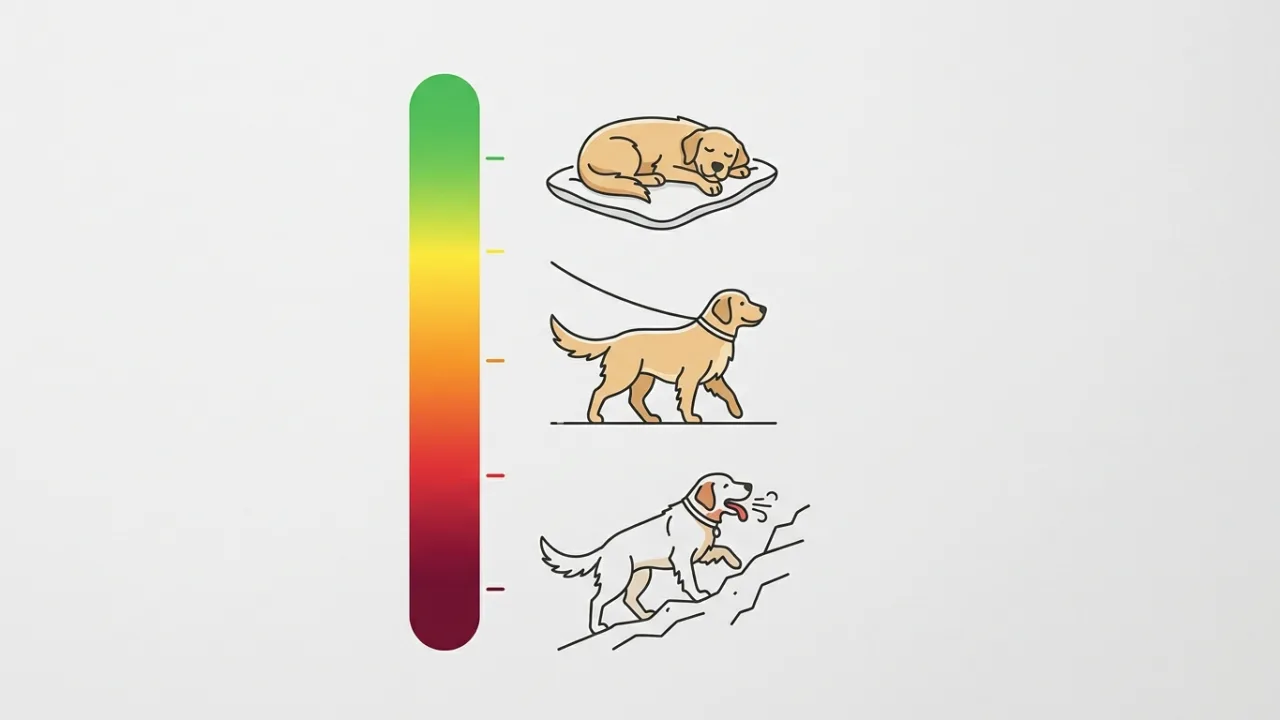
The table below adapts the EPA’s public AQI categories to the reality of trail exertion. Treat it as a planning tool, not a substitute for watching your dog’s actual behavior on the trail.
| AQI Range | EPA Category | Casual Walk | Moderate Hike (rolling hills) | Strenuous Hike / Big Elevation Gain |
|---|---|---|---|---|
| 0–50 | Good | Safe | Safe | Safe |
| 51–100 | Moderate | Safe for most dogs | Safe for most, watch at-risk breeds | Caution for brachycephalic/senior dogs |
| 101–150 | Unhealthy for Sensitive Groups | Generally fine, keep it short | Shorten distance, watch for symptoms | Higher risk — consider a lower-elevation alternative |
| 151–200 | Unhealthy | Limit time outside | Avoid hiking | Turn back or don’t start |
| 201–300 | Very Unhealthy | Brief bathroom breaks only | Do not hike | Do not hike |
| 301+ | Hazardous | Avoid outdoor exposure entirely | Do not hike | Do not hike |
Notice the drop-off between the “casual walk” and “strenuous hike” columns starts as early as the 101–150 band. That’s the exertion multiplier at work, and it’s the single biggest adjustment most guides leave out.
Human AQI Guidance vs. What’s Actually Safe for a Hiking Dog
Official AQI advisories are written for humans, and they generally treat 0–100 as fine for the general population with only sensitive groups (asthma, heart disease, older adults, children) advised to be cautious starting around 101. Dogs don’t map onto this cleanly for two reasons: they can’t tell you when their chest feels tight, and during a hike they’re often working harder, relative to their size, than the humans walking beside them.
A practical adjustment many trail-savvy vets and experienced hikers use is to treat your dog roughly the way you’d treat a “sensitive group” human, even if your dog has no known health conditions — meaning the caution threshold moves down from 150 to somewhere around 100–120 for moderate exertion, and lower still for strenuous elevation gain. If your dog is brachycephalic, senior, or has any cardiac or respiratory history, treat them like a person with severe asthma: caution starts at Moderate (51+), not Unhealthy for Sensitive Groups.
Breed and Health-Status Risk Tiers
Not all dogs experience the same AQI the same way. Flat-faced (brachycephalic) breeds already have narrowed airways and less respiratory reserve even on a clean-air day, which means they hit distress at lower particulate concentrations and show it faster.
| Risk Tier | Examples | Threshold Adjustment | Why |
|---|---|---|---|
| Brachycephalic | Pugs, French/English Bulldogs, Boxers, Shih Tzus, Boston Terriers | Turn back 30–50 AQI points earlier than standard guidance | Narrowed airways reduce filtering and increase mouth-breathing at rest |
| Senior / Cardiac-Respiratory | Older dogs, dogs with known heart murmurs, collapsing trachea, or prior respiratory illness | Turn back 20–40 points earlier | Reduced cardiovascular and pulmonary reserve |
| Standard / Endurance Breeds | Labs, Shepherds, Huskies, Vizslas, most mixed-breed dogs | Follow standard exertion-adjusted thresholds above | Still vulnerable at sustained exertion, but greater baseline reserve |
Even a healthy, athletic dog in the “standard” tier can be pushed into distress by high enough particulate levels combined with sustained climbing — breed tier changes the threshold, it doesn’t remove the risk.
Elevation, Inversions, and Why the Trailhead Reading Can Lie to You
One of the most common mistakes hikers make is checking the AQI for the nearest town and assuming it applies to the whole route. Wildfire smoke doesn’t distribute evenly across elevation. During a temperature inversion — common in mountain valleys during fire season — smoke can pool at lower elevations overnight and into the morning, then lift or shift as the day heats up. On other days, smoke plumes ride high-altitude wind currents and settle onto ridgelines and summits while valley floors stay relatively clear.
Practical takeaway: check AQI forecasts for the elevation you’ll actually be traveling through, not just the trailhead town (see: altitude sickness signs in dogs), and understand that conditions at a summit or exposed ridge can be meaningfully worse — or occasionally better — than conditions at the parking lot. Exposed ridgelines also tend to catch more direct plume drift than forested canyon trails, which can offer some natural filtering and shelter from a shifting plume. When smoke is active in the region, choosing a lower-elevation, canyon, or forested route over an exposed ridge walk is a genuinely useful risk-reduction strategy, not just a comfort preference.
Timing Your Hike Around Daily Smoke Patterns
Smoke concentration commonly follows a daily rhythm during active fire events: mornings are often clearer as smoke that settled overnight starts to lift, air quality frequently degrades through the afternoon as fires become more active and thermal winds shift, and it can worsen again in the evening as inversions re-form. Starting early and planning to be off-trail by early afternoon during active smoke events is one of the simplest, most effective adjustments you can make.
AirNow vs. PurpleAir vs. IQAir vs. State DEQ Apps: Which to Trust
Different tools pull from different data sources, and knowing the difference matters when you’re deciding whether to trust a reading enough to change your plans.
| Tool | Data Source | Offline Use | Best For |
|---|---|---|---|
| AirNow (EPA) | Regulatory-grade government monitors | No — download forecast before you lose service | Most reliable single number, but fewer monitors in remote areas |
| PurpleAir | Crowd-sourced low-cost sensors | No, and sensors can run high in humid or foggy conditions | Denser network, useful for hyperlocal trailhead-adjacent readings |
| IQAir | Blends government monitors, sensors, and satellite estimates | Limited | Decent middle-ground when AirNow coverage is sparse |
| State DEQ Apps | State-run monitoring networks | Varies; some offer text-based alerts | Good regional detail and sometimes trail-specific advisories |
If AirNow and PurpleAir disagree — which happens often, especially since PurpleAir sensors aren’t corrected for humidity the way AirNow’s are — treat the higher, more cautious reading as the one to plan around. When in doubt, more conservative is the right call for a dog who can’t tell you how she’s feeling.
Checking AQI When There’s No Cell Service
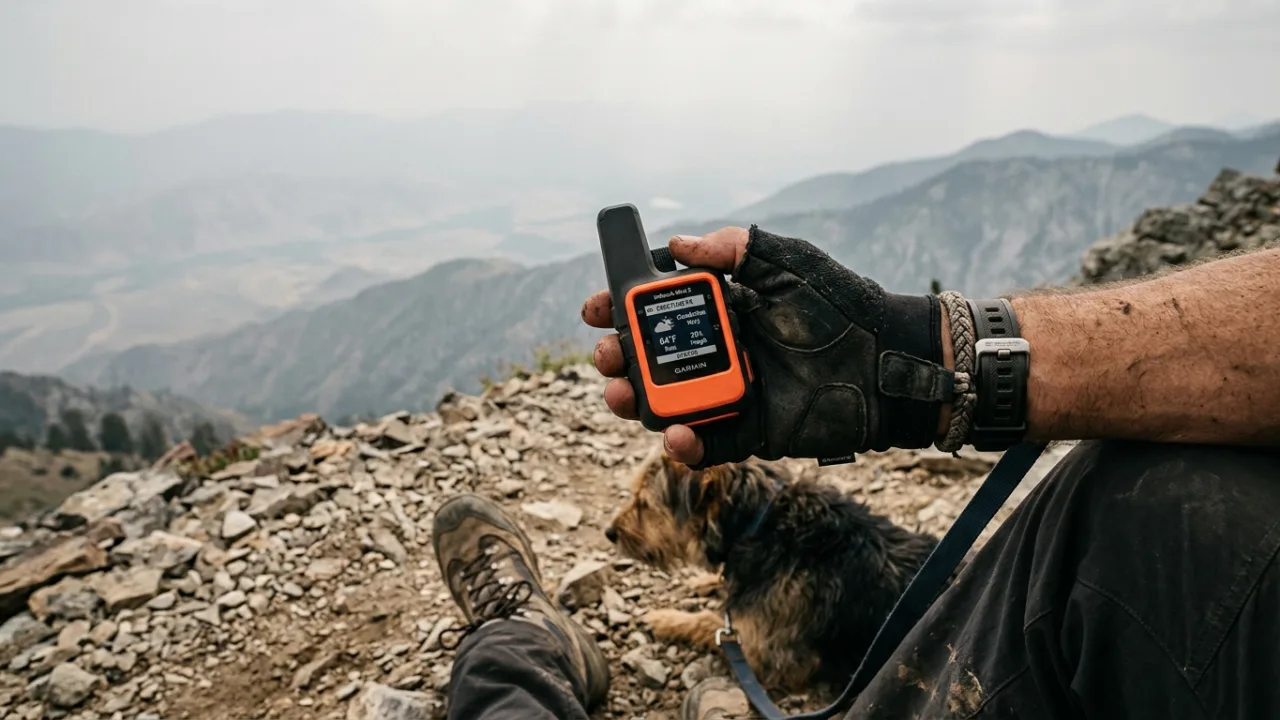
Most trailheads have signal. Most summits, canyons, and backcountry campsites do not. A few practical options: download the AQI forecast for your route and the surrounding elevation bands the night before, using an app that caches data offline; carry a satellite communicator (the kind hikers already use for emergency messaging) that includes a weather data feed, since several models now bundle basic air-quality or smoke-forecast information alongside weather; and check state forest and park websites for posted fire and smoke advisories before you leave cell range, since many post daily updates during active fire season.
Estimating Air Quality by Smell and Visibility
When no monitor data is available at all, visual and olfactory cues aren’t perfect, but they’re not nothing. A reasonably reliable rule of thumb: if you can clearly see landmarks 10+ miles away with sharp detail, air quality is likely in the Good-to-Moderate range. If visibility drops to 3–5 miles with a visible haze, assume Unhealthy for Sensitive Groups territory and treat at-risk dogs accordingly. If you can smell smoke clearly, see haze within a mile or two, or the sun looks muted/orange even at midday, treat conditions as Unhealthy or worse and don’t push a hiking dog through it, regardless of what an app said that morning.
The 90/10 Rule for Dogs
The “90/10 rule” isn’t a formal medical standard — it’s a simple field heuristic that’s useful precisely because it’s easy to remember mid-hike. The idea: on days with elevated smoke, cut your dog’s normal outdoor exertion down to roughly 10% of what you’d otherwise do, saving the other 90% of the planned activity for a cleaner-air day. In practice, that means a planned 8-mile, 2,000-foot climb becomes a 20-minute flat walk near the car, not a shortened version of the same climb. It’s a conservative mental shortcut for days when you’re tempted to “just do a bit” of a smoky hike rather than skipping it — and for brachycephalic, senior, or compromised dogs, it’s a good default any time AQI crosses into Moderate territory.
Should You Turn Back Mid-Hike? A Real Decision Protocol
Pre-hike go/no-go checks matter, but smoke conditions change during a hike far more often than most people plan for — wind shifts, a nearby fire flares, or you simply climb into a different air layer. Here’s a concrete protocol to use on trail, not just before you leave the car.
Worked Example: Trailhead AQI Reads 120, Afternoon Forecast Worse
- At the trailhead: AQI 120 (Unhealthy for Sensitive Groups). Your dog is a healthy adult Lab — standard risk tier. Per the exertion table, this is “higher risk, consider an alternative” for a strenuous route.
- Decision point: Forecast shows conditions worsening by afternoon. Choose a shorter, lower-elevation loop instead of the planned ridge summit, and plan to be back at the car by early afternoon.
- On trail, mile 2: Visibility has dropped noticeably and you can smell smoke more strongly than at the trailhead. This is your cue to reassess immediately, not wait for a scheduled break.
- Check your dog: Panting is heavier than expected for the terrain, but no coughing or gagging. This is a caution sign, not yet an emergency — shorten the remaining route and head toward the trailhead.
- Mile 3, wind shift: Smoke visibly thickens, sun turns deep orange, your dog coughs twice and sits down unprompted. This is a clear turn-back trigger — stop the hike, walk (don’t push pace) back the way you came, offering water frequently.
The lesson embedded in this example: the pre-hike AQI number is a starting filter, not a guarantee that stays valid for the whole route. Sudden thickening smoke or a wind shift should always override your original plan, even if you’re close to a summit or halfway through a multi-day itinerary.
Symptom Severity: What Means Turn Back Immediately
| Severity | Signs | Action |
|---|---|---|
| Mild | Occasional single cough, slight eye redness/irritation, mildly reduced enthusiasm | Slow pace, offer water, monitor closely for progression |
| Moderate | Repeated coughing or gagging, excessive/labored panting, reluctance to continue, disinterest in normally exciting stimuli | Turn back immediately, head toward lower elevation or cleaner air, keep pace easy |
| Emergency | Wheezing, open-mouth labored breathing at rest, gray/blue/pale gums, collapse, extreme lethargy, vomiting | Stop movement, carry if possible, seek emergency veterinary care immediately — call ahead if you have signal |
If you’re on trail without service and your dog shows emergency signs, keep exertion to an absolute minimum (carry a small dog if you can, let a large dog rest rather than pushing to the trailhead at pace), move toward lower elevation and cleaner air as the priority, and get to cell service or your vehicle as quickly as safely possible to call ahead to the nearest vet.
Two Hikers, Two Outcomes
Consider two hikers heading into the same Pacific Northwest smoke advisory on the same weekend. Both start at a trailhead reading AQI 95. The first hiker checks the number, decides it’s “basically fine,” and pushes through a planned 10-mile ridge route with 3,000 feet of gain. By mile 6, the wind has shifted, visibility has dropped to under two miles, and her dog — a middle-aged Bulldog mix — is coughing repeatedly and lagging badly. She pushes another mile to a scenic viewpoint before finally turning back, and her dog spends that evening lethargic with a persistent cough that lasts into the next day.
The second hiker checks the same trailhead reading, notes his dog is a senior Beagle with a mild heart murmur, and applies the 90/10 rule from the start — swapping the planned summit hike for a 25-minute flat walk near a lake instead. His dog shows no symptoms at all, and he saves the summit attempt for a clear-air day two weeks later. Same starting AQI, very different outcomes, because the deciding factor wasn’t the number alone — it was exertion level and breed-specific risk layered on top of it.
Day Hikes vs. Multi-Day Backpacking Trips
A single bad-air day hike is relatively easy to cancel or reroute at the last minute. A multi-day backpacking trip is harder, because permits, resupply logistics, and travel time create pressure to push forward even when forecasts turn ugly. If forecasted AQI for your route and elevation shows sustained Unhealthy-or-worse readings for more than a day of a planned trip, the safer call is to reroute to a different trailhead in a cleaner-air zone or shorten the itinerary rather than gamble on conditions improving. Cumulative exposure over multiple consecutive hiking days compounds risk in a way a single afternoon hike doesn’t — there’s no overnight “reset” if your dog is breathing smoke-laden air for 10+ hours a day, several days running.
Before a multi-day trip in a fire-active region, check the specific national park or forest’s posted alerts — many maintain smoke and air-quality advisories separate from general trail closures, and some post real-time monitor data for backcountry zones.
Ash, Paws, and Coat: A Separate Hazard From Inhalation
Inhalation isn’t the only wildfire hazard on a smoky trail. Ash and fine particulate settle on trail surfaces, and dusty, ash-covered ground can irritate paw pads and get worked into coats, leading to skin irritation independent of any breathing symptoms. After a hike in ashy conditions, check paw pads for redness or embedded debris, and rinse paws and coat with water before your dog has a chance to lick and ingest settled ash.
Streams, Lakes, and Drinking Water Near Active Smoke Events
Ash and fire-related debris can settle into open water sources near an active smoke event, and runoff from burned areas can carry contaminants into streams and lakes. When smoke is heavy enough that you can see visible ash accumulation on surfaces nearby, it’s reasonable to assume some has settled on open water too — carry sufficient water from home rather than relying on trailside sources during active smoke events, especially if you’re near a recent or ongoing burn area.
Gear Checklist for Hiking in Smoke
- Extra water — panting dogs lose fluid faster, and increased respiratory rate in smoke increases water needs further
- A downloaded, offline-accessible AQI forecast for your route and elevation
- A satellite communicator if you’re headed somewhere without reliable cell service, ideally one with a weather/conditions feed
- A collapsible bowl for frequent water breaks
- A cooling bandana or vest (helpful for heat management, not a filtration tool — more on this below) (see: cooling vests vs. bandanas)
- Contact information for the nearest veterinary clinic to your trailhead, saved before you lose signal
- A basic first-aid kit with saline for rinsing irritated eyes (see: backcountry canine first-aid kit)
Buying Advice: What’s Actually Worth Carrying
Portable PM2.5/AQI Monitors
Small handheld or clip-on PM2.5 monitors exist and can give you a real-time local reading rather than relying on a distant fixed monitor. For frequent backcountry hikers in fire-prone regions, one of these can be a genuinely useful addition to a pack, giving you a live number instead of guessing from smell and visibility alone.
Dog Respiratory Masks and Filters
Be skeptical here. Most dog-marketed respiratory masks and filters on the market lack independently verified efficacy data, and getting a proper seal on a dog’s face — especially a brachycephalic dog’s — is difficult in practice. Panting dogs need open airflow to thermoregulate, and a poorly sealed or panic-inducing mask can cause more problems than it solves. The honest guidance: don’t rely on a mask to let you hike longer or harder in smoke than the AQI otherwise supports. Reducing exertion and turning back remain the actual protective measures.
Cooling Vests and Bandanas
These help manage heat, which matters because smoky days are often also hot, high-pressure days. They do nothing to filter particulate matter and shouldn’t be marketed or used as smoke protection — think of them as a comfort and heat-safety tool that’s separate from the smoke question entirely.
Satellite Communicators
Devices that combine emergency messaging with weather data feeds are worth the investment for anyone doing regular backcountry trips in fire season, since they let you check forecast changes (and in some cases smoke outlooks) from deep in the backcountry, well outside cell range.
Post-Hike Recovery: The Monitoring Window You Shouldn’t Skip
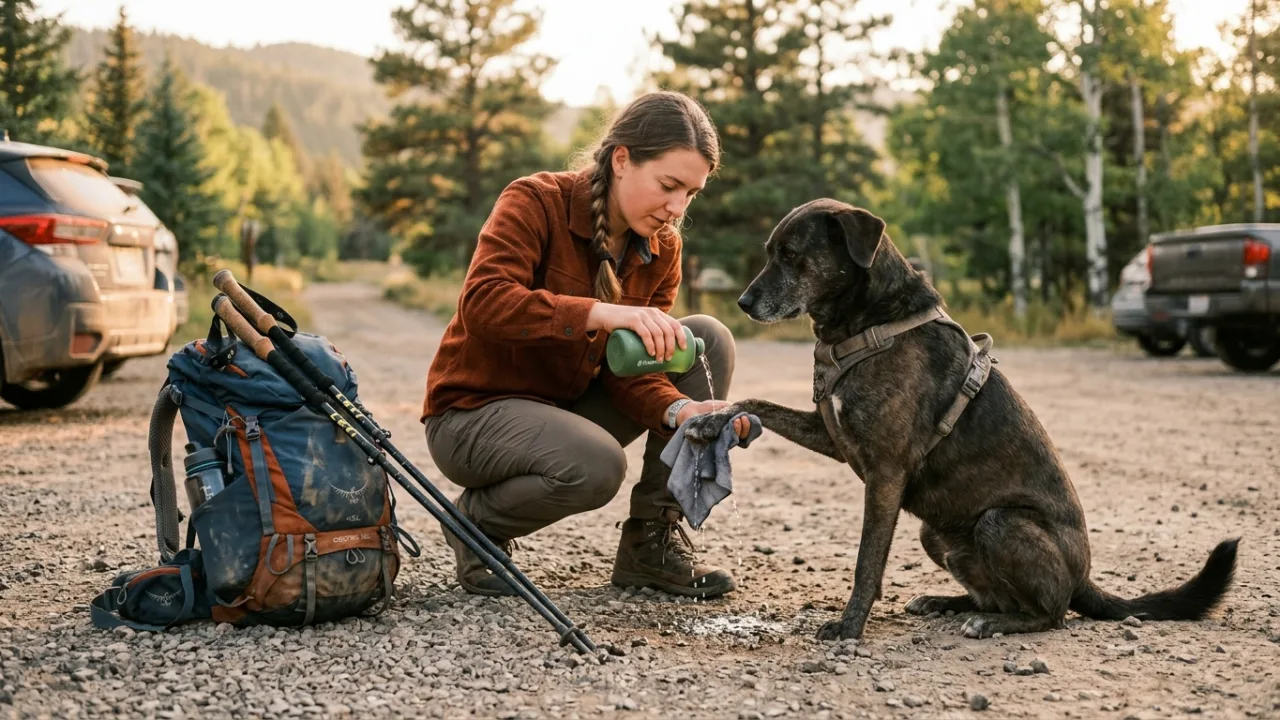
Symptoms from smoke exposure don’t always show up immediately. It’s common for mild irritation experienced on trail to resolve within a few hours, but it’s worth actively watching your dog for 24–48 hours after any hike in noticeably smoky conditions, even if she seemed totally fine at the trailhead. Watch specifically for new or worsening coughing, unusual lethargy, reduced appetite, or labored breathing at rest. A single mild cough that resolves within a day is generally not cause for alarm; persistent coughing beyond 24–48 hours, or any labored breathing at rest, warrants a veterinary visit rather than a wait-and-see approach.
Post-Hike Checklist
- Rinse ash and dust from paws, coat, and around the eyes
- Check paw pads for irritation or embedded debris
- Offer water and a quiet rest period rather than immediately resuming normal activity level
- Watch for delayed coughing or lethargy over the next 24–48 hours
- Log the day’s conditions (AQI, route, elevation, how your dog handled it) so you have a personal reference for future trips
How Long After Smoke Clears Before Normal Hiking Resumes?
Once local AQI has returned to Good-to-Moderate levels for at least a day, most healthy dogs can resume their normal hiking distance and intensity. If your dog showed any moderate symptoms (persistent coughing, marked lethargy) during a recent smoke exposure, it’s reasonable to ease back in with a shorter, lower-intensity outing first rather than immediately returning to peak mileage, giving mildly irritated airways time to settle before you ask for full aerobic effort again.
Common Mistakes Hikers Make With Dogs in Smoke
- Checking AQI once, at the trailhead, and never again. Conditions shift, sometimes within an hour, especially with wind changes.
- Using the human “safe” threshold for a dog doing far more aerobic work than the hiker.
- Ignoring elevation-specific forecasts and assuming the valley town reading applies at the summit.
- Treating a cooling vest or bandana as smoke protection when it only addresses heat.
- Pushing to “finish the route” after symptoms appear instead of turning back at the first moderate sign.
- Assuming that because the hiker feels fine, the dog is fine too — dogs’ faster breathing rate and closer-to-ground positioning (where some particulate settles) can mean real exposure differences.
What If You Feel Fine But the AQI Reading Is Elevated?
This is a genuinely common and reasonable point of confusion. Humans and dogs don’t always show symptoms at the same threshold, and a hiker’s subjective sense of “I feel okay” isn’t a reliable proxy for what’s happening in a dog’s airway, particularly for brachycephalic or senior dogs. If the AQI reading for your route and elevation is in Unhealthy-for-Sensitive-Groups territory or higher, plan around the number and your dog’s risk tier, not your own perceived comfort.
Expert Perspective: Exertion Changes the Risk Equation
Veterinarians who see patients in wildfire-prone regions of the West Coast and Mountain West consistently emphasize that the conversation around smoke and dogs shifts substantially once sustained aerobic exertion enters the picture. A dog resting in a smoky backyard and a dog climbing a mountain trail in the same air are not comparably exposed — increased respiratory rate and depth during exercise means more particulate reaches deeper into the lungs, faster. This is the same physiological principle behind why human exercise guidance during wildfire smoke events typically recommends postponing strenuous outdoor workouts well before it recommends limiting light daily activity.
From a wilderness safety standpoint, search-and-rescue and backcountry medicine perspectives generally reinforce a similar theme: exertion at altitude, combined with reduced margin for error far from care, means backcountry travelers (two- and four-legged) should apply more conservative thresholds than they would for routine errands in town. The distance from definitive veterinary care is itself a risk multiplier — a moderate symptom that would be an easy same-day vet visit in a city becomes a multi-hour evacuation problem three miles into a remote canyon.
For dogs that hike or work frequently in fire-prone regions, cumulative exposure over multiple smoke seasons is a reasonable long-term concern, similar to concerns raised about outdoor workers and cumulative particulate exposure. While comprehensive breed-specific research in dogs specifically is still limited, it’s a sound precautionary approach to treat repeated moderate-to-heavy smoke exposure as something to actively minimize over a dog’s lifetime, not just manage on a hike-by-hike basis.
Troubleshooting: When Things Don’t Go as Planned
My dog shows distress signs and I can’t reach the car quickly
Stop forward movement immediately. Move to the closest point of lower elevation or open air (away from dense timber where smoke may pool) and let your dog rest without pushing pace. Offer small amounts of water. If breathing looks labored or gums look pale/blue, prioritize getting to any point with cell signal to call ahead to a vet, even if that means backtracking rather than continuing toward your original destination.
AQI apps disagree or show no data at all
Default to the more conservative reading between any two conflicting sources. If no data is available at all, fall back on visual/smell-based estimation and apply the 90/10 rule rather than assuming conditions are fine by default.
My dog stopped and won’t continue — is it smoke or normal fatigue?
Normal fatigue usually presents as slower pace and more frequent rest requests without coughing, gagging, or changed gum color, and typically resolves with a short break and water. Smoke-related distress more often includes coughing, excessive panting disproportionate to the terrain, or reluctance that doesn’t improve with rest. When in doubt, treat it as smoke-related and turn back — the cost of a shortened hike is far lower than the cost of pushing through real respiratory distress.
Ash-covered trail surfaces are irritating my dog’s paws
Rinse paws at the first water source you trust, or carry a small amount of water specifically for paw rinsing. Booties can help on particularly ashy or hot surfaces, though many dogs need practice wearing them before a real hike.
My dog is coughing after the hike — vet visit or wait and see?
A single mild cough that resolves within several hours is usually fine to monitor at home. Coughing that persists beyond 24 hours, worsens, or is accompanied by lethargy, reduced appetite, or any labored breathing warrants a same-day or next-day veterinary evaluation rather than continued at-home monitoring.
When Hiking Isn’t Advisable: Alternative Activities for High-AQI Days
On days when the honest answer is “don’t hike,” your dog still needs mental engagement. Indoor scent work games, frozen food puzzle toys, short training sessions, and low-key backyard sniff time (kept brief if outdoor AQI is genuinely hazardous) are reasonable substitutes that don’t ask for the sustained aerobic effort that makes smoke exposure dangerous.
Pre-Hike Checklist
- Check AQI forecast for both the trailhead elevation and the highest point of your planned route
- Check the specific park or forest’s posted trail alerts and smoke advisories
- Assess your dog’s individual risk tier (brachycephalic, senior, cardiac/respiratory, or standard)
- Set a personal turn-back AQI/PM2.5 threshold before you leave, adjusted for elevation gain and planned pace
- Note the nearest veterinary clinic to the trailhead and save its contact info offline
- Pack extra water, an offline forecast, and any satellite communication device you’re bringing
The Bottom Line
There’s no single magic AQI number that applies to every dog on every trail. What matters is layering the pieces together: the base AQI reading, adjusted for how hard your dog will actually be working, adjusted again for your dog’s individual health profile, checked against elevation-specific forecasts rather than the nearest town, and reassessed on trail — not just at the trailhead — whenever smoke visibly thickens or the wind shifts. Build that habit, and you’ll rarely be caught guessing on a ridge with a coughing dog and no good options.
If you’re heading into fire season with a dog who loves the trail as much as you do, take fifteen minutes before your next hike to set a personal turn-back threshold using the tables above (see: dog-friendly hiking trails guide), save your nearest trailhead vet’s number, and download your route’s forecast before you lose signal. That small bit of prep is what turns a scary smoke encounter into a simple, calm decision to turn around and try again another day.
Frequently Asked Questions
What AQI is safe for hiking with a dog versus just walking around the block?
A short, casual walk is generally fine up to AQI 100–150 for most healthy dogs, since resting or low-effort breathing limits particulate intake. A strenuous hike with real elevation gain is a different story — sustained aerobic effort increases breathing rate and depth, so caution should start around AQI 100–120, and hiking should generally be avoided above 150, earlier still for brachycephalic, senior, or cardiac/respiratory dogs.
How do you check AQI when there's no cell service on a trail?
Download the AQI and smoke forecast for your route and elevation before you lose signal, using an app that caches data offline. A satellite communicator with a weather data feed can provide updates from deep backcountry. Without any data source, visibility distance and smell of smoke can serve as a rough, conservative estimate — reduced visibility and a strong smoke odor should be treated as elevated AQI even without a number.
Can dogs develop long-term lung damage from repeated wildfire smoke exposure while hiking?
Comprehensive research specific to dogs is still limited, but the underlying physiological risk from repeated fine-particulate exposure is well understood, and it's reasonable to treat cumulative moderate-to-heavy smoke exposure as something to minimize over a dog's lifetime, similar to concerns raised for outdoor workers. Dogs who hike frequently in fire-prone regions may benefit from more conservative thresholds during active fire seasons.
Do dog respiratory masks or filters actually work on the trail?
Most dog-marketed respiratory masks and filters lack independently verified efficacy data, and achieving a proper seal on a dog's face is difficult, especially for brachycephalic breeds. Panting dogs also need open airflow to regulate their temperature. Don't rely on a mask to justify hiking longer or harder in smoke — reducing exertion and turning back remain the actual protective strategies.
What is the 90/10 rule for dogs?
The 90/10 rule is a practical field heuristic, not a formal medical standard: on days with elevated smoke, cut your dog's planned outdoor exertion down to roughly 10% of normal, saving the rest for a cleaner-air day. In practice, an 8-mile hike becomes a 20-minute flat walk, rather than a shortened version of the same climb. It's a useful default for brachycephalic, senior, or health-compromised dogs whenever AQI crosses into Moderate territory.
Should I still hike with my dog if I personally feel fine but the AQI reading is elevated?
Yes, plan around the AQI reading rather than your own comfort level. Dogs often show symptoms at different thresholds than humans, particularly brachycephalic or senior dogs, and a hiker's subjective sense of feeling fine isn't a reliable indicator of what's happening in a dog's airway during sustained exertion.
Are exposed ridgeline trails riskier than forested canyon trails during smoke events?
Often, yes. Exposed ridges tend to catch more direct smoke plume drift, while forested canyons can offer some natural shelter and filtering, though this varies by specific fire and wind pattern. When smoke is active in a region, choosing a lower-elevation or canyon route over an exposed ridge or summit hike is a reasonable, practical way to reduce exposure.
What should I pack in case smoke conditions worsen while already on trail?
Carry extra water for increased panting, an offline-accessible AQI forecast, a collapsible bowl, saline for eye irritation, and the contact information for the nearest veterinary clinic saved before losing signal. A satellite communicator with a weather feed is a valuable addition for longer or more remote trips.
Is it safe to camp overnight in an area with moderate AQI even if daytime hiking was fine?
Use caution. Smoke often settles into valleys and campsites overnight during temperature inversions, meaning air quality at a low-lying camp can be worse overnight than it was on the trail during the day. Check the overnight forecast specifically, not just the daytime reading, before committing to camp in a smoke-affected area.
How long after smoke clears is it safe to resume normal hiking distances and intensity?
Once local AQI returns to Good-to-Moderate levels for at least a day, most healthy dogs can resume normal hiking. If your dog showed moderate symptoms like persistent coughing during a recent smoke exposure, ease back in with a shorter, lower-intensity outing first before returning to full mileage and pace.