If you’ve typed “how to fly with a cat” into a search bar at midnight while staring at a half-packed suitcase and a suspicious feline, you’re in good company. Flying with a cat is completely doable — thousands of cats travel safely every year — but it does take real preparation, and the advice scattered across airline websites rarely tells the whole story. This guide pulls it all together in one place.
TLDR: The Quick Answer
- Cats almost always fly in-cabin, not free. Expect a $95–$150 pet fee each way on most U.S. airlines.
- The carrier must fit under the seat in front of you — soft-sided carriers around 17–18″ L x 11″ W x 11″ H fit most major airlines.
- Book the pet spot as soon as you book your ticket. Airlines cap the number of cabin pets per flight, often to just a handful.
- Domestic flights generally require no health certificate; international flights almost always do, plus microchip and sometimes an USDA APHIS endorsement issued within 10 days of travel.
- Sedation is generally not recommended by veterinarians because of respiratory and blood pressure risks at altitude. Natural calming methods are the safer default.
- Cargo travel should be treated as a last resort — it’s riskier and increasingly restricted, especially in extreme temperatures.
Now let’s go through every part of the journey in detail.
Can You Bring a Cat on a Plane for Free? Understanding Pet Fees
No — flying with a cat is not free on any major U.S. or international airline. Cats are classified as “pets in cabin,” and airlines charge a fee to cover the paperwork, cabin space allocation, and staff handling. Typical in-cabin cat fees on major U.S. carriers run roughly $95 to $150 each way, and this is usually a flat rate regardless of your ticket class. Budget carriers sometimes charge less, but they may also have stricter carrier size limits or fewer cabin pet slots per flight.
The one real exception is a legitimate, trained service animal, which is not the same as an emotional support animal. Since the Department of Transportation’s 2021 rule change, airlines no longer have to treat emotional support animals as service animals — they’re now booked and charged exactly like a regular pet. Only dogs trained to perform a specific task for a person with a disability qualify for the fee waiver and expanded access that service animals receive. A cat, however well-behaved, is booked as a standard in-cabin pet.
Can I Buy an Extra Seat for My Cat’s Carrier?
Some airlines allow you to purchase an additional seat to place the carrier beside you instead of under the seat, though the carrier generally still needs to stay in its bag with the cat inside — it isn’t a way to let your cat roam free. Not every airline permits this, so call ahead before assuming you can buy a second seat for your cat’s comfort.
The 3-3-3 Rule for Cats — and Why It Matters for Flying
The 3-3-3 rule is a well-known guideline among cat behaviorists and shelters describing how a cat adjusts to a new environment: the first 3 days are overwhelmed and hiding, the next 3 weeks they start settling in, and by 3 months they feel fully at home. Applied to air travel, this rule is a useful reminder that a flight is just the beginning of an adjustment period, not the whole story. Your cat may seem withdrawn, clingy, or off their food for the first three days after landing — this is normal, not a sign that something went wrong. Understanding the 3-3-3 rule helps owners set realistic expectations and avoid panicking over normal post-travel decompression behavior (more on this in the post-flight care section below).
Domestic vs. International Cat Travel: Side-by-Side Comparison
| Requirement | Domestic Flights | International Flights |
|---|---|---|
| Health certificate | Usually not required | Almost always required, often within 10 days of travel |
| Rabies vaccination proof | Rarely checked | Required by nearly every destination country |
| Microchip | Recommended, not always required | ISO-compliant microchip typically required |
| USDA APHIS endorsement | Not applicable | Required for many countries, especially EU nations |
| Quarantine | None | Varies — some countries (UK, Australia, Hawaii) have strict entry protocols |
| Booking lead time | 1–3 weeks recommended | 4–8 weeks recommended for paperwork alone |
| Carrier & cabin rules | Standard airline pet policy | Same, plus destination-specific import permits |
Airline Pet Policy Comparison: Major U.S. Carriers
Every airline sets its own rules for carrier size, fees, and how many pets are allowed per cabin. Policies change, so always confirm directly with the airline before booking, but here’s a general snapshot to help you compare at a glance.
| Airline | Typical In-Cabin Fee (one-way) | Carrier Size Limit (approx.) | Cabin Pets per Flight | Notes |
|---|---|---|---|---|
| Delta | $95–$125 | 18″ x 11″ x 11″ | Limited, capped per cabin | Cabin-only program; no cargo pet shipping |
| United | $125–$150 | 17.5″ x 12″ x 11″ | Limited via PetSafe cabin program | Offers a dedicated cabin pet reservation system |
| American | $125–$150 | 18″ x 11″ x 11″ | Limited, first-come reservations | Requires advance reservation confirmation |
| Southwest | ~$95 | 18.5″ x 8.5″ x 13.5″ | Limited per flight | No advance seat assignment complicates carrier placement |
| JetBlue | ~$125 | 17″ x 12.5″ x 8.5″ | Limited | JetPaws program includes small perks for pet travelers |
| Alaska | ~$100 | 17″ x 11″ x 9.5″ | Limited | Fee often lower than legacy carriers |
| Spirit | ~$110–$135 | 18″ x 14″ x 9″ | Limited | Budget carrier; still requires advance reservation |
Figures are general ranges based on commonly published airline policies at the time of writing and can change. Always verify current fees and dimensions directly with the airline before you fly.
Choosing the Right Carrier: Soft-Sided vs. Hard-Sided
| Feature | Soft-Sided Carrier | Hard-Sided Carrier |
|---|---|---|
| Fits under seat | Usually flexes to fit tight spaces | Rigid dimensions, less forgiving |
| Comfort | More cushioned, feels den-like | More structured, better for anxious cats who chew or scratch |
| Ventilation | Mesh panels on multiple sides | Vents but less airflow overall |
| Airline preference | Preferred by most cabin pet programs | Accepted by fewer airlines for cabin use |
| Best for | Most cabin flights | Cats who need extra durability or as a backup for cargo situations |
For nearly all in-cabin flights, a well-ventilated soft-sided carrier with a locking zipper, a leak-proof base, and enough room for your cat to turn around and lie down is the safest, most compliant choice. Measure it against your specific airline’s under-seat dimensions before you buy — a carrier that’s compliant on one airline may not fit under the seat on another.
Your Pre-Flight Timeline: What to Do and When
| Timeline | Action Items |
|---|---|
| 8 weeks before | Book flight and reserve the cabin pet spot immediately; if traveling internationally, contact a USDA-accredited vet to start paperwork and check destination quarantine rules; confirm your cat is microchipped with an ISO-compliant chip. |
| 2 weeks before | Begin carrier acclimation sessions daily; schedule the vet visit for the health certificate if flying internationally (many countries require it within 10 days of travel, so timing matters); pack a travel kit. |
| 48 hours before | Confirm health certificate paperwork is finalized; do a trial run zipping your cat into the carrier for 30–60 minutes; check weather forecasts for embargo restrictions at connecting airports. |
| Day of travel | Withhold a large meal a few hours before departure; offer a small amount of water; do a final litter break; arrive early to allow time for TSA screening with a pet. |
Acclimating Your Cat to the Carrier Before Travel
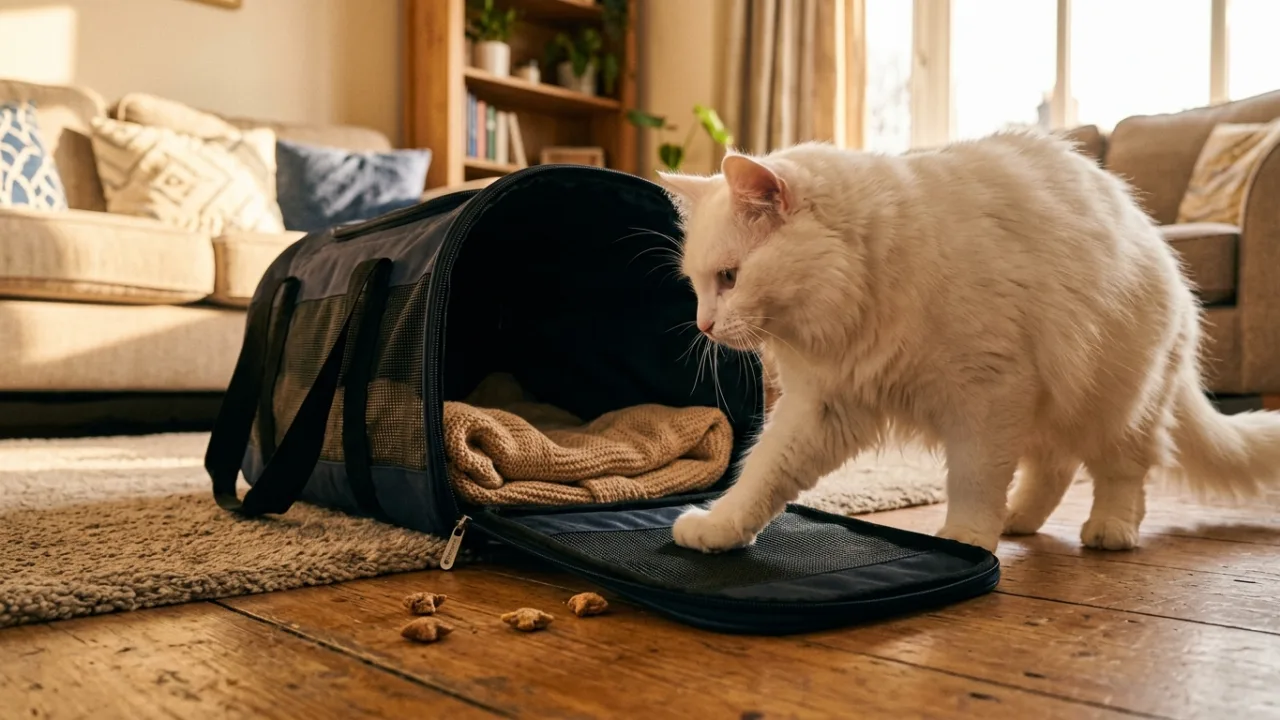
Veterinary behaviorists consistently recommend introducing the carrier as a positive space weeks before travel rather than pulling it out of the closet the morning of your flight. Leave the carrier open in a common room with a soft blanket and treats inside so your cat can explore it on their own terms. Feed meals near or inside the carrier, and gradually work up to short practice sessions with the door closed, then short walks around the house or a quick trip in the car. By the time travel day arrives, the carrier should feel like a familiar den rather than a trap — this single step does more to reduce flight-day stress than almost anything else on this list.
Health Certificates, Vaccinations, and Microchips
Domestic Flights
Most U.S. domestic flights do not require a health certificate, though airlines may ask for proof of rabies vaccination, especially on longer routes. It’s smart to carry vaccination records anyway, just in case.
International Flights
International travel is a different story. Nearly every destination country requires an official health certificate, and many require it to be issued by a USDA-accredited veterinarian within 10 days of travel — not 10 days of booking, 10 days of the actual flight date. This tight window is one of the most common reasons pet travel plans fall apart, so build your vet appointment around your flight date, not the other way around.
For countries in the EU and several others, you’ll also need a USDA APHIS endorsement (see: USDA APHIS endorsement process), which is a federal review and stamp confirming your vet’s certificate meets the destination’s import requirements. This step can take several business days depending on your region, which is why starting paperwork 4–8 weeks ahead is standard advice from pet travel consultants and USDA-accredited vets alike.
International Document Checklist
- Health certificate issued by a USDA-accredited veterinarian (check the required issue window for your destination)
- USDA APHIS endorsement, if required
- Proof of rabies vaccination, with dates matching your destination’s minimum waiting period
- ISO-compliant microchip, implanted before the rabies vaccination for most countries’ timelines
- Any destination-specific import permit (Hawaii, the UK, and Australia have particularly detailed protocols) (see: UK's detailed import protocols)
- Rabies titer test results, if your destination requires it (common for rabies-free islands and Australia)
International Entry Requirements by Destination (General Overview)
| Destination | Health Certificate Window | Microchip | Rabies Titer Test | Quarantine |
|---|---|---|---|---|
| United Kingdom | Within days of travel per current scheme | Required, ISO-compliant | Sometimes, depending on origin country | None if all steps completed correctly; otherwise possible |
| Australia | Detailed multi-step process, months in advance | Required | Required | Mandatory quarantine period on arrival |
| Hawaii (from mainland US) | Health certificate plus rabies documentation | Required | Sometimes, depending on prior compliance | Can range from none to several days depending on documentation completeness |
| European Union | Within 10 days of travel | Required, implanted before vaccination | Not usually required from the US | None if compliant |
Rules for each country change periodically, so treat this table as a starting point and always confirm current requirements with the destination country’s official agriculture or biosecurity agency and a USDA-accredited veterinarian before booking.
Going Through TSA With a Cat: Step by Step
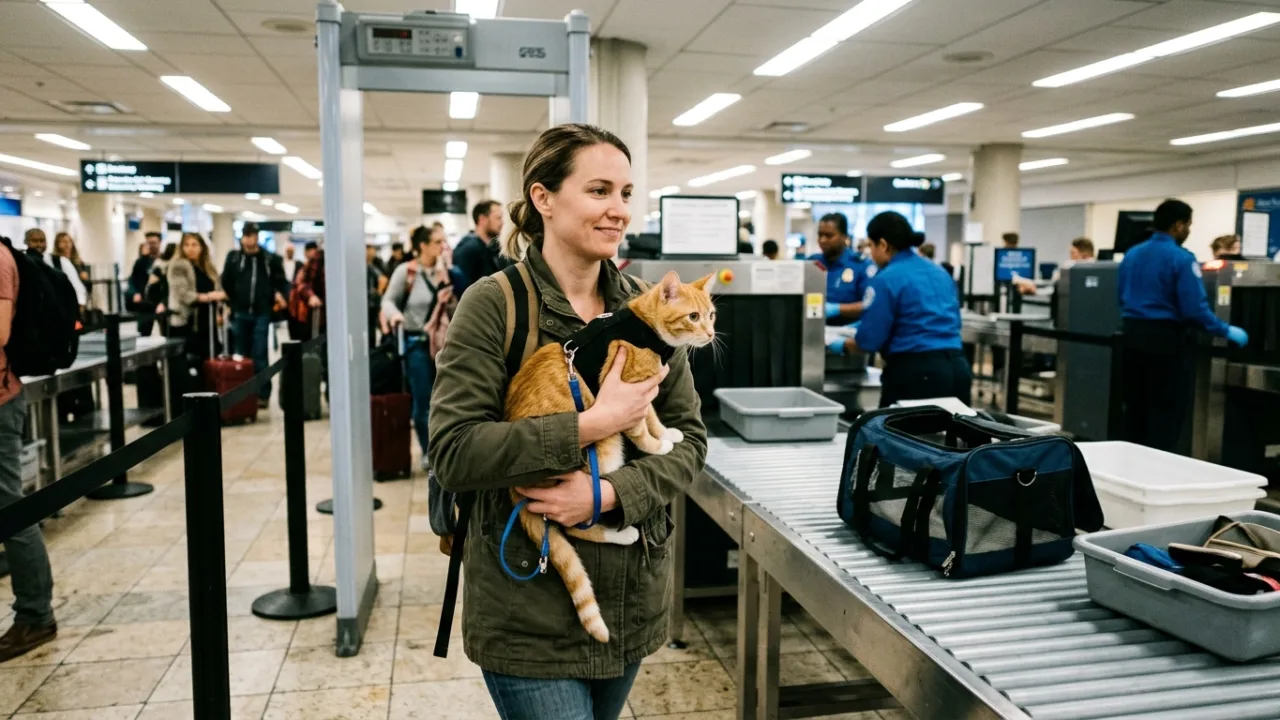
Airport security is the part that makes most cat owners nervous, but it becomes manageable once you know the sequence. (see: clearing a TSA checkpoint)
- Arrive early. Pet screening takes longer than a normal security pass, so build in extra buffer time.
- Put your cat in a harness and leash before you get to the checkpoint so you have control the moment they come out of the carrier — this is one detail seasoned cat travelers wish they’d known sooner.
- Remove your cat from the carrier and carry them through the metal detector or body scanner in your arms while the empty carrier goes through the X-ray belt.
- Keep a firm, calm hold using the harness handle so your cat can’t bolt if they get startled by the noise or the crowd.
- Repack your cat into the carrier immediately on the other side, away from the flow of foot traffic, before gathering your other belongings.
Practicing this exact sequence — harness on, out of the carrier, held securely, back in the carrier — during your acclimation sessions at home will make the real thing far less chaotic.
What If My Cat Escapes at the Airport?
If your cat slips the harness or bolts, stay calm and don’t chase them into a crowd, which can make them panic further. Alert TSA or airport staff immediately — most airports have protocols for this exact situation and will help contain the area. This is precisely why a properly fitted harness (tested at home beforehand) matters so much more than a collar, which can slip off in a moment of panic.
Sedation vs. Natural Calming Methods
This is one of the most searched — and most misunderstood — questions in cat air travel. Veterinary guidance generally leans away from sedating cats for flights. Sedatives can affect a cat’s blood pressure and breathing, and these effects can be harder to monitor and more risky at altitude, where cabin pressure and oxygen levels differ from the ground. Because of this, many veterinarians recommend reserving sedation only for specific medical situations discussed directly with your vet, rather than as a routine travel tool.
Natural calming alternatives are the safer starting point for most cats:
- Feliway or similar pheromone sprays, applied to the carrier well before travel (not directly on the cat), can help signal safety and reduce stress behaviors.
- Calming wraps or thundershirts, which apply gentle, constant pressure similar to swaddling, work well for some cats though results vary by individual.
- Familiar bedding or an unwashed shirt with your scent on it inside the carrier.
- Carrier acclimation (covered above), which has the biggest long-term impact on how calm your cat is during travel.
If your cat has severe anxiety or a medical condition that makes flying especially risky, talk to your veterinarian well before your trip. They may discuss anti-anxiety medications that are lighter than traditional sedatives and have been evaluated for your cat’s specific health profile — this is a conversation to have weeks in advance, not the night before your flight.
Cabin Travel vs. Cargo Travel
Cats should fly in the cabin whenever at all possible. Cargo travel involves temperature swings, less monitoring, and more handling by multiple people, all of which add stress and risk. Most major U.S. airlines have moved away from offering cargo pet shipping for cats specifically because of these risks, and many now offer cabin-only pet programs. Cargo should really only be considered when there is no other option — for instance, an oversized cat that cannot fit any compliant in-cabin carrier — and even then, it’s worth exploring a specialized pet relocation service rather than standard airline cargo, since these services are built specifically around animal safety and temperature control.
A Real Sample Day-of-Travel Timeline (Domestic Flight)
- 6:00 AM – Wake up, offer a small amount of water, skip a full breakfast for your cat.
- 6:30 AM – Final litter box visit at home.
- 7:00 AM – Cat goes into the carrier with a familiar blanket and a treat.
- 7:30 AM – Leave for the airport, carrier secured with a seatbelt in the car.
- 8:30 AM – Arrive at the airport, check in, confirm the pet reservation at the counter.
- 9:00 AM – Security screening: harness on, cat carried through the scanner, repacked calmly.
- 9:30 AM – Wait at the gate in a quieter corner away from heavy foot traffic.
- 10:00 AM – Board early if the airline offers it, carrier under the seat, cat settled before the crowd boards.
What to Feed (and Withhold) Before a Flight
To reduce the chance of an accident in the carrier, offer a lighter meal several hours before departure rather than a full meal right before you leave. Water can be offered in small amounts up until close to departure, but many cat owners find it easier to slightly reduce water intake in the hour before travel rather than cutting it off entirely, since hydration still matters. A final litter box visit right before leaving home is one of the simplest ways to prevent mid-travel accidents.
What if My Cat Has an Accident in the Carrier?
Pack absorbent puppy pads or a washable liner underneath the carrier bedding so any accident is contained and easy to swap out. If it happens mid-flight, a few extra pee pads and unscented wipes in your travel kit let you do a quick clean-up in the airplane bathroom or at your seat as discreetly as possible. Bring a spare liner and a sealable bag for the soiled one — this single packing decision saves a lot of stress if an accident happens at 30,000 feet.
Can I Bring a Litter Box for a Long-Haul Flight?
For long international flights, a small disposable or collapsible litter tray can be brought, though most airlines won’t have a dedicated space to use it mid-flight — this is really a tool for layovers and airport pet relief areas rather than in-seat use. Many international airports now have designated pet relief areas past security (see: designated pet relief areas), and some larger U.S. airports have family or companion animal restrooms that work well for a quick litter break during a layover. Check your connecting airport’s pet relief area location in advance so you’re not searching for it with a stressed cat in tow.
In-Flight Cat Travel Kit Checklist
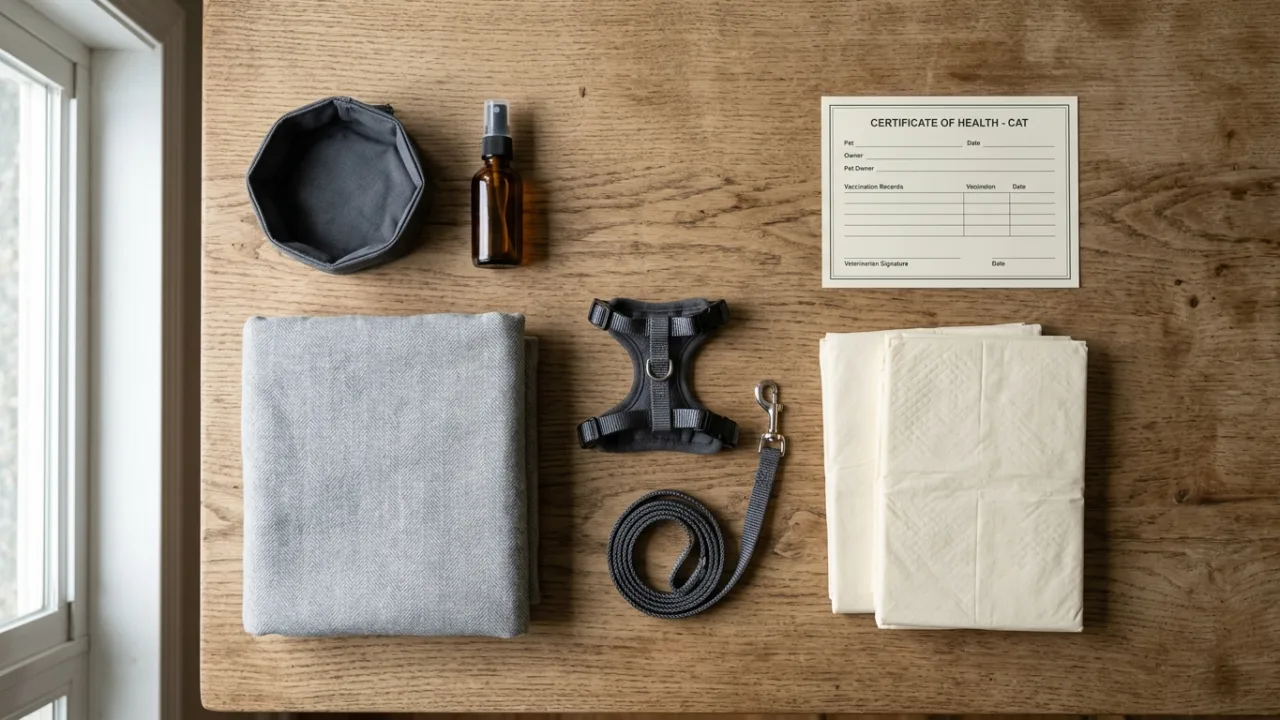
- Collapsible travel bowl
- Small bottle of water and a water syringe for offering sips discreetly
- Absorbent pee pads and a spare carrier liner
- Unscented wipes and waste bags
- A familiar blanket or worn shirt with your scent
- A few treats your cat already loves
- Pheromone spray, applied to the carrier before boarding
- Copy of health certificate and vaccination records (printed and digital backup)
- ID tags with your current cell number, even if your cat is microchipped
Managing a Meowing, Anxious, or Panicking Cat Mid-Flight
Some vocalizing during takeoff is common and usually not a sign of danger — cabin pressure changes and engine noise are simply unfamiliar. Speak in a low, calm voice, rest a hand gently on top of the carrier so your cat can feel your presence without being handled, and avoid opening the carrier mid-flight, which risks an escape in a confined cabin. If meowing continues, a small treat offered through the mesh or a few drops of water can help redirect focus. Watch for more serious stress signals — excessive panting, drooling, or a cat pressed flat against the carrier floor — and if you see these, alert a flight attendant, since some carriers keep basic guidance on hand for exactly this situation. Most cats settle within the first 20–30 minutes once engine noise becomes a steady hum rather than a series of new sounds.
Ear Pressure During Takeoff and Landing
Cats can experience ear discomfort during pressure changes just like people do. Offering a small treat to encourage swallowing during takeoff and landing can help equalize pressure, and keeping the cabin around your cat calm and quiet reduces the compounding stress of a pressure change plus a loud environment.
Kittens, Multiple Cats, and Brachycephalic Breeds
How Old Does a Kitten Need to Be to Fly?
Most airlines require kittens to be at least 8–12 weeks old, and some set the minimum higher, around 16 weeks, particularly for international travel where vaccination timelines must already be complete. Always check both the airline’s minimum age policy and your destination country’s requirements, since the stricter of the two applies.
Traveling With Multiple Cats
Airlines typically allow one pet carrier per passenger, and many cap it at one cat per carrier for safety and space reasons, even if two cats could technically fit. If you’re traveling with more than one cat, expect to book multiple pet reservations (and pay multiple pet fees) and confirm this arrangement directly with the airline, since cabin pet caps per flight mean two reservations aren’t automatically guaranteed on the same flight.
Flat-Faced (Brachycephalic) Breeds
Persians and other flat-faced cat breeds are more prone to breathing difficulty, and while most airlines don’t outright ban them from cabin travel the way they restrict some brachycephalic dog breeds from cargo, it’s worth a pre-flight vet check for these cats specifically, since heat and stress can worsen existing breathing challenges.
Weather Embargoes and Connecting Flights
Many airlines apply seasonal temperature embargoes that can affect connecting pet itineraries (see: layover rules for pets), particularly around extreme summer heat or winter cold at layover cities, even for in-cabin pets whose carrier might sit briefly on the tarmac during transfers. Booking direct flights whenever possible avoids this issue entirely and also cuts down on the total time your cat spends in transit, reduces the number of security screenings, and lowers the odds of a missed connection creating a rushed, stressful transfer. If a connection is unavoidable, build in extra layover time so you’re not sprinting between gates with a carrier in hand.
What Happens If My Flight Gets Delayed or Cancelled?
If your flight is delayed with your cat already checked in for cabin travel, stay with your cat since they generally remain with you rather than being separately stored. Ask the gate agent about nearby pet relief areas if the delay stretches long, and keep your travel kit accessible rather than checked. If your flight is cancelled and you’re rebooked, confirm your pet reservation carries over — cabin pet caps mean a new flight may already be full, so speak to an agent promptly rather than assuming the reservation transfers automatically.
What If the Gate Agent Says My Carrier Doesn’t Meet Size Requirements?
This is rare if you’ve measured carefully in advance, but it does happen, especially on smaller regional aircraft with tighter under-seat space. Keep your carrier’s dimensions and airline confirmation email accessible on your phone, and remain calm and polite — most issues get resolved by double-checking the specific aircraft type’s under-seat measurements, which can be smaller on regional jets than on mainline aircraft even for the same airline.
Post-Flight Decompression: Helping Your Cat Settle Back In
Once you’re home or at your destination, set up a small, quiet room with familiar bedding, food, water, and a litter box, and let your cat come out of the carrier on their own terms rather than pulling them out. Remember the 3-3-3 rule here: don’t be alarmed if your cat hides for a day or two, eats less than usual, or seems unusually clingy or distant. Keep the household calm, avoid introducing new people or pets right away, and give your cat several days before expecting them to act fully like themselves again.
Is It Cruel to Fly With a Cat?
This is a fair question, and the honest answer is that flying is stressful for most cats, but stress is not the same as harm. With proper carrier acclimation, a calm travel routine, and attentive in-flight care, the large majority of healthy adult cats tolerate air travel reasonably well and recover within days. The bigger welfare concerns arise around cargo travel, extreme temperatures, and cats with pre-existing heart or respiratory conditions — situations where a conversation with your veterinarian beforehand is essential. If your cat has a known heart condition, severe anxiety disorder, or is elderly with health complications, ask your vet directly whether flying is appropriate for them at all, rather than assuming every cat is a good candidate for air travel.
Cost Breakdown: What Flying With a Cat Really Costs
| Item | Estimated Cost Range |
|---|---|
| Airline in-cabin pet fee (each way) | $95–$150 |
| Health certificate (domestic vet visit) | $50–$150 |
| International health certificate + USDA endorsement | $150–$300+ |
| Airline-compliant soft-sided carrier | $40–$100 |
| Calming aids (pheromone spray, wrap) | $20–$40 |
| Microchip (if not already done) | $40–$60 |
Common Mistakes to Avoid
- Booking the flight without reserving the pet spot. Cabin pet caps fill up, sometimes weeks ahead on popular routes.
- Buying a carrier without checking the specific airline’s under-seat dimensions. “Airline-approved” labeling varies — always verify measurements yourself.
- Waiting until the week before an international flight to start paperwork. Health certificates and APHIS endorsements have strict timing windows.
- Skipping carrier practice sessions. A cat’s first time in the carrier should never be the morning of the flight.
- Feeding a full meal right before departure. This increases the risk of an accident or nausea.
- Using a collar instead of a harness for TSA screening. Collars slip off far more easily during a startled moment.
- Assuming a delay or cancellation automatically keeps your pet reservation. Always confirm with an agent directly.
Final Thoughts
Flying with a cat rewards preparation more than almost any other kind of pet travel. The owners who have the smoothest trips are rarely the ones with the calmest cats by nature — they’re the ones who started carrier training early, booked their pet reservation the moment they booked their flight, and built in extra time for security, paperwork, and layovers. Take it step by step using the checklists above, lean on your veterinarian for anything medical, and give your cat grace to decompress once you land. It’s a lot of moving pieces, but thousands of cat owners manage it successfully every year, and with this guide, you’re already ahead of most of them.
If you found this guide helpful, explore more of All Happy Pets’ air travel resources to keep building your pre-flight checklist, and don’t hesitate to call your airline’s pet travel line directly with any airline-specific questions before you book.
Frequently Asked Questions
What is the 3-3-3 rule with cats?
The 3-3-3 rule describes how cats adjust to new environments: 3 days feeling overwhelmed and hiding, 3 weeks settling in, and 3 months feeling fully at home. Applied to flying, it's a reminder that your cat may act withdrawn or clingy for a few days after travel — this is normal decompression, not a sign that something went wrong.
Can you bring a cat on an airplane in the cabin for free?
No, nearly all airlines charge an in-cabin pet fee, typically $95–$150 each way, regardless of your ticket class. The only common exception is a legitimate trained service animal, which is different from an emotional support animal — since 2021, ESAs are booked and charged as regular pets.
How do I go through TSA with a cat?
Put your cat in a harness and leash before reaching the checkpoint, remove them from the carrier, and carry them through the metal detector or scanner while the empty carrier goes through the X-ray belt. Hold the harness firmly, then repack your cat into the carrier immediately once through, away from foot traffic.
What if my cat meows on a plane?
Some vocalizing during takeoff is common and usually not concerning. Speak calmly, rest a hand on the carrier, and offer a treat or water through the mesh. Avoid opening the carrier mid-flight. If you notice excessive panting, drooling, or extreme distress, alert a flight attendant right away.
Is it cruel to take a cat on a plane internationally?
Flying is stressful for most cats, but stress alone isn't the same as harm. With carrier acclimation, calming aids, and attentive care, most healthy adult cats tolerate air travel and recover within days. Cats with heart, respiratory, or severe anxiety issues should be evaluated by a vet before international travel is attempted.
How do I fly with a cat litter box on a long flight?
A small collapsible or disposable litter tray can be packed for layovers rather than in-seat use, since most flights don't offer space to use one mid-air. Many international airports have designated pet relief areas past security — check your connecting airport's location in advance for a quick litter break.
Can you bring a cat on a plane internationally without quarantine?
Yes, in many cases, as long as all documentation — health certificate, microchip, rabies vaccination timing, and any required titer test — is completed correctly and on time. Countries like the UK and parts of the EU can often be quarantine-free with full compliance, while others like Australia have mandatory quarantine regardless.
Do cats need to be sedated to fly?
No, and most veterinarians generally advise against routine sedation for flights due to potential effects on blood pressure and breathing at altitude. Natural calming methods like pheromone sprays, calming wraps, and carrier acclimation are the recommended first approach; sedation should only be discussed directly with your vet for specific medical situations.
What size carrier is allowed under the seat on major airlines?
Most major U.S. airlines require carriers around 17–18.5 inches long, 11–14 inches wide, and 9–11 inches tall, though exact dimensions vary by airline and even by aircraft type. Always check your specific airline's current measurements and consider that regional jets may have smaller under-seat space than mainline aircraft.
How old does a kitten need to be to fly?
Most airlines require kittens to be at least 8–12 weeks old, though some set the minimum around 16 weeks, especially for international travel where full vaccination schedules must be completed first. Check both the airline's policy and your destination country's minimum age requirements before booking.